December 11, (THEWILL) — President Bola Tinubu on Wednesday unveiled a comprehensive national security and economic framework aimed at unlocking Nigeria’s vast maritime and aquatic resources, describing the blue economy as a critical pathway to economic transformation.
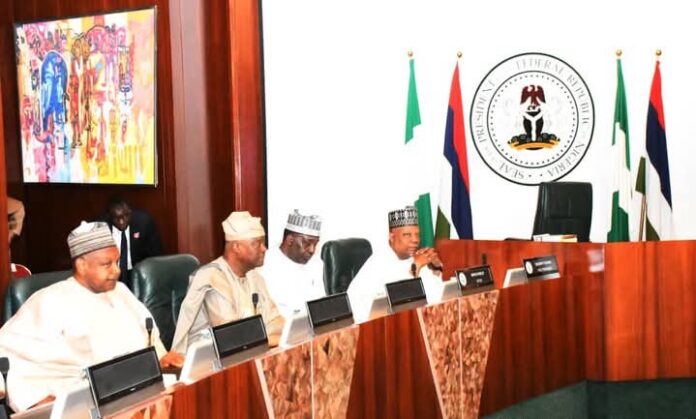
Speaking at the Presidential Villa during a session with participants of the Senior Executive Course 47 of the National Institute for Policy and Strategic Studies (NIPSS), the President, represented by Vice President Kashim Shettima, directed all relevant ministries, departments, and agencies to immediately review and implement the institute’s recently submitted study on blue economy development.
Tinubu emphasised the administration’s commitment to converting Nigeria’s underutilised marine potential into a major driver of economic diversification, job creation, and long-term prosperity.

“The blue economy offers a strategic pathway for diversifying our revenue base, creating sustainable employment, and revitalising ecosystems that sustain national development. If properly harnessed, this sector could become an anchor of shared prosperity for generations,” he said.
Commending NIPSS for its analytical rigour and patriotism, the President described the report titled “Blue Economy and Sustainable Development in Nigeria: Issues, Challenges and Opportunities” as a timely roadmap highlighting opportunities to pursue and challenges to overcome.
Noting Nigeria’s strategic advantage with its 853-kilometre coastline, rich fisheries, inland waterways, and location in the Gulf of Guinea, Tinubu outlined the administration’s priorities: aquaculture expansion, maritime corridor and port modernisation, coastal tourism, marine biotechnology, and renewable ocean energy.
“These opportunities lie within our grasp if we act with discipline and intentionality,” he said.
The President also highlighted the creation of the Ministry of Marine and Blue Economy as a key reform to enhance port management, strengthen maritime security, and attract private-sector investment.
However, he warned that persistent security threats could undermine these ambitions.
While acknowledging progress in reducing piracy through the Deep Blue Project, Tinubu cautioned that oil theft, illegal fishing, vandalism, smuggling, and kidnapping continue to drain national wealth and erode investor confidence.
“These threats are real, and this administration is taking decisive steps to address them,” he stated.
To further strengthen national security planning, the President directed NIPSS to conduct a nationwide security diagnostic and produce actionable recommendations to guide ongoing reforms in the country’s security architecture.
He assured that the resulting policy paper would “receive the utmost attention.”
Earlier, NIPSS Director-General, Prof. Ayo Omotayo, thanked the President for his support and acknowledged the Minister of Finance and Coordinating Minister of the Economy, Wale Edun, for funding the course.
He said participants visited several Nigerian states and 14 countries to inform their findings.
Presenting highlights of the report, Colonel Murkar Dauda noted that the Federal Government is already addressing systemic gaps in the blue economy sector.
He identified governance constraints, weak institutional coordination, poor policy coherence, and substandard infrastructure as major barriers.
Despite these challenges, the report emphasised the immense economic opportunities available.
It singled out fisheries and aquaculture as entry points for rapid economic gains, recommending a national fisheries expansion programme to increase production from 1.2 metric tonnes to 10 metric tonnes within two years through public-private partnerships.
Other recommendations include expanding the sector’s revenue base, developing a comprehensive blue economy financing framework, harmonising legal and policy instruments, enhancing security across inland waterways, and establishing a marine skills, jobs, and social inclusion programme.
The Presidency assured that all recommendations will be carefully considered as part of ongoing efforts to reposition Nigeria’s blue economy for sustainable national development.

Felix Ifijeh is a journalist with years of professional reporting experience. Known for his keen news sense, compelling storytelling and commitment to accurate, impactful reporting, he has built a reputation for turning leads into clear, engaging, and well-structured reports that resonate with readers. His work reflects deep newsroom experience and a commitment to accurate, impactful journalism.