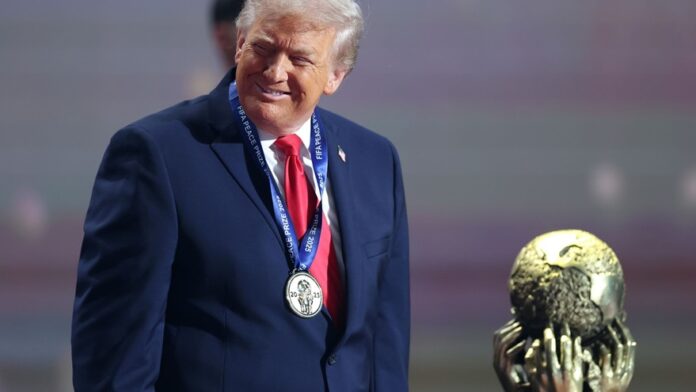
December 08, (THEWILL) — One evening in Washington, as diplomats and football officials gathered at the Kennedy Centre for the Performing Arts to witness the draw for the 2026 men’s World Cup, sport and politics collided in a ceremony that will likely define FIFA’s reputation for years to come. About 30 minutes into the proceedings, FIFA President Gianni Infantino presented United States President Donald Trump with the inaugural FIFA Peace Prize, a gold trophy depicting hands cradling a globe, accompanied by a certificate and medal. The moment, broadcast to millions worldwide, was intended to celebrate global unity through football, yet it immediately plunged the occasion into controversy, raising fundamental questions about the independence of international sporting bodies.
The prize, officially titled the FIFA Peace Prize – Football Unites the World, was created in November 2025 to recognise individuals whose actions promote peace and unity. FIFA provided no details about nominees or the selection process, and when pressed, a spokesperson declined to explain how Trump was chosen. Reports in the media suggested that several senior officials within the organisation expressed surprise at the decision, fuelling suspicions that the award bypassed normal governance structures. Some sources indicate the FIFA Board initiated a probe into whether Infantino acted unilaterally, echoing concerns from the 2015 corruption crisis that led to arrests and Infantino’s eventual election as president.
The relationship between Infantino and Trump has deepened considerably since the United States, Canada and Mexico secured the 2026 hosting bid in 2018. Infantino attended Trump’s inauguration in January 2025 and has spoken publicly of his friendship with the president, whom he reportedly addresses as “Johnny”. He joined Trump at a Gaza ceasefire signing in Egypt in October and appeared at the renamed Donald J. Trump Institute of Peace the day before the World Cup draw, where Trump facilitated an agreement between Congolese and Rwandan leaders aimed at curbing violence in eastern Congo. FIFA has leased office space in Trump Tower, appointed Ivanka Trump to the board of a $100 million education fund linked to World Cup ticket sales and Infantino visited the Oval Office in August to discuss visa processes for tournament visitors. These connections have raised alarms about FIFA’s independence, particularly as Trump holds considerable leverage over critical logistics, such as players’ visas and he has threatened to relocate matches from cities not aligned with his policies.

For FIFA, the stakes could hardly be higher. The 2026 tournament represents the organisation’s largest expansion yet, with 48 teams competing across 16 cities in three countries over 104 matches between June and July. The United States hosts 11 of these venues, making American governmental cooperation essential for everything from stadium preparations to security arrangements and, crucially, the processing of millions of visas for visiting fans, officials and athletes. Infantino’s gesture may therefore be interpreted less as an endorsement of foreign policy than as a calculated effort to guarantee frictionless passage for the football tournament, even at the cost of the organisation’s stated political neutrality.
Trump’s acceptance speech highlighted his administration’s diplomatic record, which FIFA cited in justifying the prize. Calling the honour “one of the greatest of my life”, he claimed to have ended eight wars since taking office in January 2025 and saved millions of lives through conflict resolution. He referenced ceasefires in Gaza and Ukraine, alongside agreements involving Armenia and Azerbaijan, Thailand and Cambodia, Kosovo and Serbia, India and Pakistan, and Egypt and Ethiopia. The Congo-Rwanda accord, signed hours before the ceremony, addresses mineral-rich border disputes, though violence flared shortly after the agreement was announced.
Nevertheless, independent reporting contradicts several of Trump’s claims. India’s government has consistently denied that the United States played a meaningful third-party role in discussions with Pakistan. In Gaza, whilst a two-year conflict between Israel and Hamas concluded with a fragile truce in October 2025, Israeli forces continue to occupy parts of the territory with sporadic strikes persisting. Over 500 Palestinian footballers died during the war, according to human rights reports. In Ukraine, Trump’s administration pursued direct negotiations with Russia, yet President Vladimir Putin has rejected key proposals and combat continues. The Congo-Rwanda deal, meanwhile, aims to address fighting rooted in the 1994 Rwandan genocide, but clashes involving over 100 armed groups persist despite the agreement.
The award arrives after years of Trump’s vocal pursuit of the Nobel Peace Prize, an honour that has remained elusive despite his administration’s best efforts. The FIFA Peace Prize functions as a powerful substitute, a kind of validation manufactured within the friendly confines of a major sports organisation. The sudden creation of the award and its immediate conferral upon a world leader who has repeatedly expressed frustration at being overlooked by the Norwegian Nobel Committee suggests a move intended to placate and flatter, rather than reward verifiable achievement.
It is worth noting that Trump’s record includes support for Israel’s Gaza operations and domestic policies targeting immigrants through Immigration and Customs Enforcement and National Guard deployments. The administration also faces scrutiny for lethal strikes on suspected drug boats in the Caribbean, described by legal experts as extrajudicial killings. Recent rhetoric labelling people from Somalia as “refuse from hell” clashes starkly with football’s diverse, migrant player base.
FIFA’s statutes mandate political neutrality, and the organisation has historically fined or disciplined national associations and players for making political statements, even those related to human rights. Awarding a political prize to a sitting, politically active head of state represents a considerable contradiction to this stated mission.
The move opens FIFA to accusations of hypocrisy and establishes a dangerous precedent, blurring the lines between sport and governance in ways that risk alienating football federations and fans worldwide who believe the game should remain separate from partisan politics.
The cost of this accommodation may be FIFA’s remaining institutional credibility. The award is less a celebration of global peace than a monument to the complex, compromised reality of modern sports geopolitics, a twisted bargain in which a sporting body trades independence for guaranteed political support. The golden trophy may gleam, yet the deeper test lies in whether Trump’s claimed peaces hold or fracture further, and whether football can reclaim its role as a unifying force untainted by political theatre.

Jude Obafemi is a versatile senior Correspondent at THEWILL Newspapers, excelling in sourcing, researching, and delivering sports news stories for both print and digital publications.