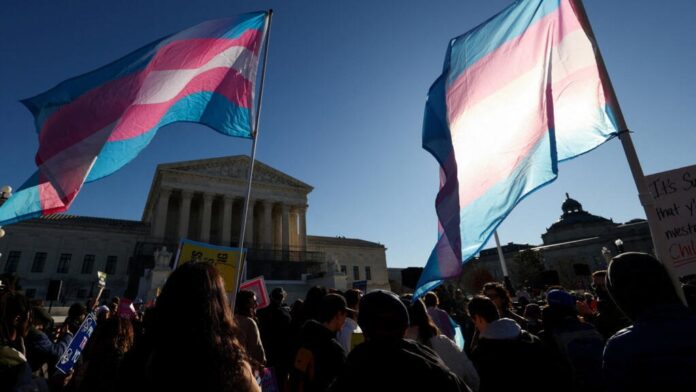
June 30 (THEWILL) — The United States Supreme Court on Tuesday upheld state laws barring transgender girls and women from competing on girls’ and women’s sports teams in public schools and colleges, handing a significant victory to states that have enacted restrictions based on biological sex.
In a 6-3 decision, the court ruled that states may legally require student-athletes to participate in school sports according to their sex assigned at birth, affirming laws passed in West Virginia and Idaho.
Justice Brett Kavanaugh, writing for the majority, said maintaining separate sports teams for biological males and biological females is constitutionally permissible because of the physical differences between the sexes.

“Separate sports teams for biological males and biological females are reasonable,” Kavanaugh wrote, arguing that such policies help ensure fair competition and reduce the risk of physical injury for female athletes.
He further held that the challenged state laws do not amount to unlawful sex discrimination under the Constitution.
Chief Justice John Roberts joined the majority opinion alongside Justices Clarence Thomas, Samuel Alito, Neil Gorsuch, and Amy Coney Barrett.
The decision does not invalidate policies in California and 22 other states that permit transgender students to compete according to their gender identity.
However, the ruling is expected to influence similar laws across the United States and further intensify the national debate over transgender rights, gender identity, and fairness in athletics.
The judgment may also strengthen President Donald Trump’s efforts to pressure California into changing its transgender athlete policy by threatening to withhold about $8 billion in federal education funding, although any such action is expected to face further legal challenges.
In a dissenting opinion, Justice Sonia Sotomayor criticised the court for deciding the constitutional issues before lower courts had fully examined scientific evidence concerning transgender athletes and competitive advantage.
“The majority decision inflicts a hardship on those it disfavors without giving them the fair and full opportunity the Constitution requires,” Sotomayor wrote.
“She argued that transgender athletes should have been allowed to present evidence on the effects of hormone therapy and other medical treatments on athletic performance before the court reached a final decision.
Justices Elena Kagan and Ketanji Brown Jackson joined the dissent.
The cases before the Supreme Court arose from legal challenges filed by two transgender students.
One plaintiff, Becky Pepper-Jackson, challenged West Virginia’s 2021 law after seeking to compete on her school’s girls’ track and cross-country teams.
Lower courts had permitted her participation while the litigation continued, and she recently won the state’s girls’ high school shot put championship.
The second case involved Lindsay Hecox, who challenged Idaho’s Fairness in Women’s Sports Act after attempting to join the women’s track team at Boise State University.
Although Hecox did not make the team, the lawsuit proceeded because of the broader constitutional questions raised by the legislation.
Joshua Block, an attorney with the American Civil Liberties Union (ACLU), who represented both athletes, said they were reportedly the only openly transgender student-athletes competing in school sports in their respective states when the cases reached the Supreme Court.
Supporters of the state laws argued that the restrictions are necessary to protect competitive fairness and preserve equal athletic opportunities for girls and women.
Attorneys general from 26 Republican-led states told the court that the laws simply recognise biological differences between males and females and ensure female athletes are not placed at a competitive disadvantage.
Opponents, including California, 14 other states, and the District of Columbia, argued there is no credible evidence that transgender girls who undergo medical treatment retain an unfair athletic advantage.
They maintained that participation in school sports is closely linked to students’ academic achievement, physical health, and emotional well-being.

Felix Ifijeh is a journalist with years of professional reporting experience. Known for his keen news sense, compelling storytelling and commitment to accurate, impactful reporting, he has built a reputation for turning leads into clear, engaging, and well-structured reports that resonate with readers. His work reflects deep newsroom experience and a commitment to accurate, impactful journalism.