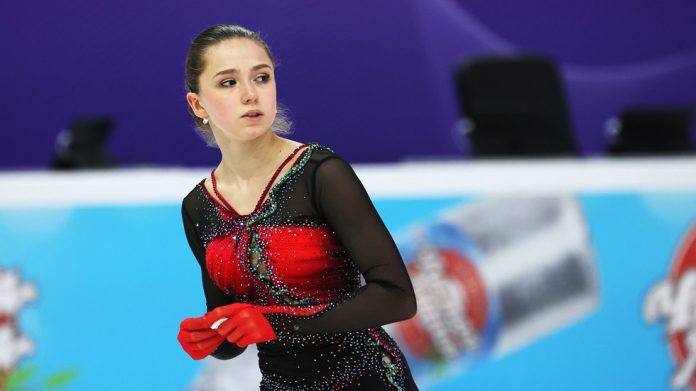
February 15, (THEWILL) – The World Anti-Doping Agency (WADA) claims that the Russian Anti-Doping Agency (RUSADA), failed to mark Kamila Valieva’s sample as a priority, resulting in an adverse analytical finding during the 2022 Winter Olympics in Beijing.
The 15-year-old was allowed to compete in the women’s singles figure skating event on Monday, after a Court of Arbitration for Sport (CAS) panel decided against upholding her provisional suspension.
According to the panel of the highest arbitration body in sports, there were “serious issues of untimely notification of the results of the athletes’ anti-doping test.”

The Panel, chaired by Fabio Iudica of Italy, claimed that this “infringed upon the athletes’ ability to establish certain legal requirements for her benefit”, despite the fact that such late notification was not her fault, and came in the middle of the Olympic Winter Games Beijing 2022.
The interval between the sample collection on December 25 and the analysis on February 8, when the positive test was verified by the WADA-accredited laboratory at Karolinska University Hospital in Stockholm, was underscored by CAS director general Matthieu Reeb.
“These anti-doping testing procedures had been completed in one week or 10 days as generally the case for example at the Olympic Games.” Reeb stated.
Following the CAS judgement, WADA published a statement claiming that the Panel had chosen not to apply the WADA Code, which ” does not allow for specific exceptions to be made in relation to mandatory provisional suspensions for ‘protected persons’, including minors.”
The statement from WADA on the panel’s decision read: “Concerning the analysis of the athlete’s sample, WADA always expects Anti-Doping Organisations to liaise with the laboratories in order to ensure they expedite the analysis of samples so that the results are received prior to athletes traveling to or competing in a major event, such as the Olympic or Paralympic Games and, where applicable, conduct results management of the cases related to such athletes.
“According to information received by WADA, the sample in this case was not flagged by RUSADA as being a priority sample when it was received by the anti-doping laboratory in Stockholm, Sweden. This meant the laboratory did not know to fast-track the analysis of this sample.
“As previously announced, under the terms of the Code, when a minor is involved in an anti-doping case, there is a requirement to investigate that athlete’s support personnel.
“RUSADA has already indicated it has begun that process. In addition, WADA’s independent Intelligence and Investigations Department will look into it.”
On their part, the RUSADA said on Saturday, February 12, that the delayed analysis of the sample was due to an outbreak of the Omicron form of COVID-19. At the time, the COVID-19 variety was spreading rapidly across their camp location in Sweden.

Jude Obafemi is a versatile senior Correspondent at THEWILL Newspapers, excelling in sourcing, researching, and delivering sports news stories for both print and digital publications.