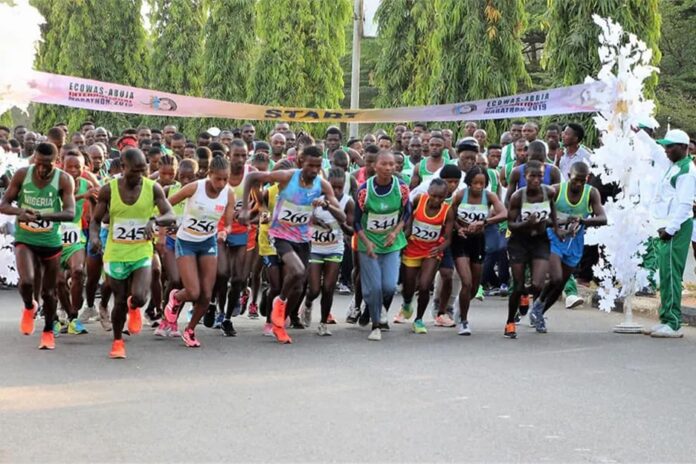
December 14, (THEWILL) — When the gun fired at the Abuja City International Half Marathon on 6 December, it marked more than just the start of a 21-kilometre race through Nigeria’s capital. The event had earned a World Athletics Bronze Label in only its second year, a feat that typically takes organisers far longer to achieve and one that signals a significant shift in the landscape of African road running. For a country where elite distance racing has long been overshadowed by sprint success and dominated by Lagos as the sole destination for international competition, Abuja’s rapid ascent represents both validation and challenge.
World Athletics does not distribute its labels casually. The Bronze designation confirms that the course meets exacting international standards for measurement, that anti-doping protocols are enforced and that safety measures and technical oversight reach levels demanded by the sport’s global governing body.
These are not cosmetic achievements. They transform a domestic event into one where times are globally recognised, results appear on international rankings and athletes from around the world have reason to compete. The Abuja race now sits alongside a select group of African events that meet these criteria, joining the Access Bank Lagos City Marathon in offering Nigerian runners a platform that can genuinely advance their international prospects.

The speed with which organisers Nilayo Sports Management Limited achieved this status deserves scrutiny. Having already guided the Lagos City Marathon to Gold Label recognition, the company brought proven expertise to Abuja. Yet expertise alone does not guarantee success in a country where sports infrastructure often disappoints and where past races have faced criticism over crowd control and course accuracy. The 2025 edition drew over 2,800 participants from 13 countries, with an elite field of approximately 30 runners from Kenya, Ethiopia, Uganda and Nigeria. Traffic management through the Garki and Wuse districts proceeded smoothly, medical stations operated without incident, and timing systems functioned to World Athletics specifications. These operational details matter because they form the bedrock upon which labels are maintained or revoked in annual reviews.
The competitive results told a familiar yet nuanced story. Kenya’s Kephar Namutala claimed victory in the men’s race with a time of 1:05:14, followed by compatriots Edwin Kipyago and Ezekiel Chepkovomi, completing a clean sweep of the podium. This dominance by East African runners is hardly surprising given their depth in distance running and high-altitude training advantages. What the result confirms is that the race attracted genuine international competition rather than token foreign entries. For Nigerian male athletes, however, the outcome offers a sobering assessment. Adamu Shehu finished eighth overall in 1:08:25, earning him recognition as the top local finisher and prize money of $4,000 plus 2 million naira. Yet the three-minute gap between him and the winner represents more than a kilometre of road, a statistical reality that underscores how far Nigerian men must progress to challenge East African long-distance hegemony.
The women’s race provided a more encouraging narrative. While Kenya’s Mercy Jepkemoi took first place in 1:14:53, Nigerian runners Shambor Solomon and Akusho Thomas finished in second and third positions with times of 1:16:28 and 1:17:24 respectively. These podium finishes break the psychological pattern of East African monopolies and demonstrate that with proper preparation and the incentive of competing at home, at least Nigerian women can close the competitive distance. The Athletics Federation of Nigeria publicly acknowledged these results as evidence that the country’s endurance training programmes are yielding tangible progress, a claim that gains credibility when results are recorded on World Athletics-certified courses.

The financial architecture supporting the event reveals deliberate strategy. Premium Trust Bank, as sole sponsor, invested in a total prize purse of $25,000 for elite athletes, with $8,000 awarded to winners and descending amounts to eighth place. Separate cash prizes for Nigerian finishers and a new student category offering up to N1 million broadened participation beyond the elite field. Critics sometimes argue that ring-fencing prizes for local athletes breeds complacency, but in the current climate it functions as essential support. Without these incentives, many Nigerian distance runners lack the means to train full-time or compete regularly, making the dual prize structure a pragmatic necessity rather than protectionism.
The economic implications extend beyond prize money. International road races draw participants and support personnel who require accommodation, transport and hospitality services. Whilst definitive figures remain unavailable for the 2025 Abuja event, established patterns from other cities hosting labelled races suggest measurable economic activity. This commercial dimension helps justify support from the Federal Capital Territory Administration and the National Sports Commission, whose director general Bukola Olopade attended the finish line to present awards. The involvement of government officials signals alignment between private sector execution and public sector policy, a partnership model that reduces taxpayer burden whilst delivering professionally managed events.
There remains debate about nomenclature. Some sources suggest that World Athletics no longer officially uses the term “Bronze Label,” instead categorising the Abuja recognition simply as a World Athletics Label, the entry level in the current system. This distinction matters less to athletes and spectators than to technical observers, yet it highlights the difference between promotional language and governing body terminology. What cannot be disputed is that the race now appears on the official World Athletics calendar for 2025, subjecting it to ongoing scrutiny and requiring continued compliance with technical regulations.
For Nigeria, which already hosts the Okpekpe 10km road race and the Lagos City Marathon, the Abuja half marathon adds momentum to an emerging tradition of internationally recognised distance events. The country’s ambitions in road racing connect to broader goals of developing distance athletes capable of competing at Olympic and world championship level, arenas where Nigeria has historically excelled in sprints but not marathons since 1992. The policy framework emphasises public-private partnerships to fund training centres and scholarships, with events like the Abuja race serving as practical expressions of this vision.
The challenge ahead is consistency. Labels are reviewed annually, and any lapse in standards, delayed prize payments or safety protocol failures can result in revocation. Organisers have expressed ambitions to upgrade to Platinum Label status within three years, requiring deeper international fields and faster times. Abuja’s infrastructure, including wide roads and the national stadium, supports such expansion. The question is whether sustained sponsorship, improved athlete development programmes and operational excellence can be maintained year after year. The 2025 edition provided the blueprint. Whether it becomes the baseline or a peak achievement will determine Abuja’s lasting impact on the African road racing landscape.

Jude Obafemi is a versatile senior Correspondent at THEWILL Newspapers, excelling in sourcing, researching, and delivering sports news stories for both print and digital publications.