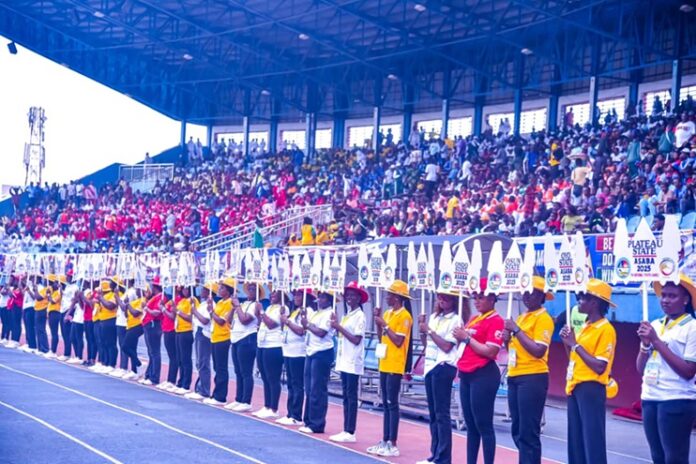
September 01, (THEWILL) — President Bola Tinubu declared the ninth National Youth Games (NYG) open on August 29, 2025 at the Stephen Keshi Stadium in Asaba, Delta State. He spoke through his Special Adviser on Media and Public Communications, Sunday Dare, who represented him at the ceremony. Tinubu described the Games as a platform for finding and developing talents that have represented Nigeria in local, continental, and international competitions.
The president confirmed his government’s promise to support sports growth, pointing to recent help given to teams such as the Super Falcons and D Tigress. He praised the National Sports Commission, led by Mallam Shehu Dikko as chairman and Honourable Bukola Olopade as Director General, for their work in youth and grassroots sports. He also thanked the Delta State government for hosting the event and noted that Asaba has become a centre for sports events in Nigeria.
Delta State Governor Sheriff Oborevwori, represented by the Speaker of the State House of Assembly, Right Honourable Emomotimi Guwor, called the Games a celebration of Nigeria’s youth, unity and future. He said Delta State had continued the practice of hosting the Games for the third time, showing investments in modern sports facilities, youth support and local competitions. He stressed the state’s focus on identifying young talents early and giving them chances to succeed and honour Nigeria. Olopade, in his speech, highlighted the games’ purpose in connecting local talents to higher levels of performance.
The Games feature 6,382 athletes under the age of 15 from all the 36 states and the Federal Capital Territory, competing in 37 sports. These include karate, weightlifting, athletics, swimming, boxing, taekwondo, volleyball, and chess, among others. The total number of athletes and officials exceeds 7000, which marks the highest participation since the Games began. Delta State fields 382 athletes and 143 technical officials. Benue State and Borno State did not send teams, with no details provided on their absence.

The large number of participants created difficulties for the Local Organising Committee, who had to make quick plans for extra housing and services. One committee member, Festus Ohwojero, said the turnout was not expected, as some states sent more athletes than in previous years. The Committee worked to ensure everyone had a place.
Competitions started before the official opening, with medals awarded in several sports. The first gold medal went to Anointed Nkemonso Isaac, a 14-year-old from Cross River State, in the female minus 47 kilogramme kumite karate event. Team Akwa Ibom won three medals early on, making a strong start. Magdaline Inji from Nasarawa State earned her team’s first medal after four fights in a combat sport. Delta State, which has topped the medal table in all eight previous editions, aims to keep its position.
The National Youth Games began in 2013 at the National Stadium in Abuja, organised by the Federal Government through the National Sports Commission. The first edition had over 4000 athletes, and 370 new talents were found. Cross River State won overall, with Akwa Ibom State in second place and Delta State in third. The games aim to develop young people into skilled athletes and build unity among states. They started during the time of former President Goodluck Jonathan.
From 2016 to 2021, Ilorin in Kwara State hosted the games several times due to a successful 2016 event and an agreement between the University of Ilorin and the Federal Ministry of Youth and Sports Development to host for five years. In 2017, Delta State won with 21 gold, 16 silver, and 23 bronze medals. By 2021, Delta State had won six times in a row, with 60 gold, 27 silver, and 29 bronze medals that year. Lagos State placed second with 19 gold, 26 silver, and 28 bronze, and Edo State third with 18 gold, 10 silver, and 11 bronze.
Delta State hosted the seventh edition in 2023 at Dennis Osadebay University in Asaba, but it was delayed due to national elections. The eighth edition also took place in Asaba in 2024, where Delta State won again with 41 gold medals. This pattern shows Delta State’s strong position in youth sports.
Preparations for the ninth edition included closed training camps for teams like Delta State, which started last month. The National Sports Commission handled registration online, confirming the final number of athletes. The opening ceremony included marches by athletes from each state, cultural shows, and music from popular artists. Teams such as Kwara State stood out in the march past, led by Coach Bilikis Magaji.
The games play a key role in Nigeria’s sports system by finding talents early and preparing them for higher levels. Many past participants have gone on to represent Nigeria in major events. The focus on under-15 athletes helps build a strong base for future success. The event also promotes national unity, as athletes from different states come together in friendly competition.
However, issues such as absent states and housing problems point to areas for improvement. The high turnout shows growing interest in youth sports, but it requires better planning and resources. Government support, as promised by Tinubu, could help address these needs and expand the games’ reach.
State teams have different goals. Delta State seeks to extend its winning run. Lagos State aims to improve from past positions. Anambra State, which finished ninth in 2023 and eighth in 2024, hopes for better results this year. Kogi State expresses hope for wins.
The ninth National Youth Games continue until September 6, with daily competitions in various venues across Asaba. Early medal wins set the stage for intense rivalries. The event not only awards medals but also builds skills, discipline, and friendships among young Nigerians. It aligns with national goals for youth empowerment and sports as a tool for social good.
Investments in facilities and training, as seen in Delta State, provide a model for other states. The success of this edition could encourage even more participation in future years and strengthen Nigeria’s sports culture. Indeed, the ninth National Youth Games in Asaba represent a vital step in developing Nigeria’s young athletes. With strong government backing and local efforts, the event promises to contribute to the nation’s sports future while addressing current challenges in organisation and inclusion.

Jude Obafemi is a versatile senior Correspondent at THEWILL Newspapers, excelling in sourcing, researching, and delivering sports news stories for both print and digital publications.