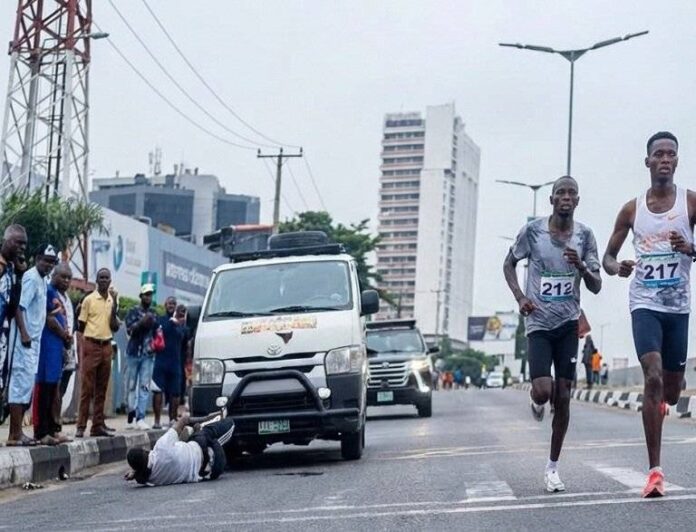
February 16, (THEWILL) — A serious lapse in event safety has cast a shadow over what should have been a triumphant milestone for one of Africa’s most prestigious athletic gatherings. On Saturday, during the 11th Access Bank Lagos City Marathon, an official ambulance struck a designated female spectator near the finish line, raising urgent questions about the management of emergency vehicles in crowded race environments and the protocols that govern their deployment during major sporting events.
The woman, identified as a non-athlete who was present in the finishing area, sustained bruises and chest pain after the vehicle made contact with her whilst transporting runners who had required medical attention earlier in the race. Video footage of the collision, which spread rapidly across social media platforms, shows the ambulance approaching from behind a group of runners before the impact occurred. Emergency workers halted the vehicle immediately and provided first aid at the scene before transferring her to a health facility. According to the Lagos State Government, her vital signs were stable and she is now responding positively to treatment under professional supervision. Senior officials from both the Ministry of Health and the Lagos State Sports Commission have visited the hospital to monitor her recovery.
Yet the reassuring news of her condition has done little to dampen public concern about how such an incident could occur during a Gold Label marathon that attracts thousands of international competitors and spectators. Gbenga Omotoso, the Commissioner for Information and Strategy, confirmed that a thorough investigation is under way to establish the full circumstances surrounding the event. The probe will examine the actions of the ambulance crew, the coordination between medical responders and traffic authorities, and the movement of emergency vehicles within areas for runners and spectators.

The Access Bank Lagos City Marathon has grown rapidly since its inception in 2016, when it became Nigeria’s first full marathon in more than 30 years. Drawing over 20,000 participants in its debut year, the event earned a Bronze Label from World Athletics after just two editions, a rare achievement that reflected both the quality of the organisation and the ambition of its backers. By 2026, it had reached Gold Label status, cementing its place on the international racing calendar and attracting elite athletes from Kenya, Ethiopia and beyond. This year’s race was won by Kenya’s Ezra Kipchumba Kering in a time of two hours and 11 minutes, with Ethiopia’s Dinke Meleka taking first place in the women’s category.
The marathon’s success has transformed it into a flagship event for Lagos, one that promotes health and fitness whilst showing the city’s capacity to host world-class sporting competitions. The 42-kilometre course, which starts at the National Stadium in Surulere and finishes at Eko Atlantic City, requires extensive logistical planning and significant investment from sponsors, organisers and city authorities. Roads and intersections are closed to unauthorised traffic, with personnel from the Lagos State Traffic Management Authority and other security agencies positioned along the route to enforce the planned closures. Oluwaseun Osiyemi, the Commissioner for Transportation, had assured the public that these measures would prevent unauthorised vehicles from entering the marathon corridors.
The presence of ambulances at intervals along the course is standard practice in mass-participation events, designed to ensure that runners or spectators who fall ill or are injured can receive timely care. The official race guidelines stipulated that medics and emergency vehicles would be stationed at regular points to respond to distress calls. However, the deployment of motorised vehicles within a restricted zone where thousands of people are gathered requires precise coordination, and the collision has exposed potential gaps in that system. The finish line area is typically one of the most congested sections of any marathon, with spectators pressing against barriers to cheer on competitors. The movement of a large ambulance through this space, even on an emergency mission, presents inherent risks if not managed with extreme caution.
Public reaction to the video has been one of shock and dismay. The question of concern is whether vehicles should operate within such crowded sections of the race whilst runners and spectators are still present. The incident suggests that whilst emergency access is essential, the balance between rapid medical response and crowd safety may have been poorly calibrated. The investigation is expected to consider whether the driver followed established speed limits for the race area and whether communication between medical teams, security personnel and race officials was adequate.
The Lagos incident has prompted a broader debate about the operational standards required for events of this scale. For the Access Bank Lagos City Marathon to maintain its international standing and pursue higher classifications from global athletic bodies, the findings of the current investigation will be critical. Officials have indicated that lessons learned will be integrated into planning for future editions of the race. This may involve stricter zoning where vehicles are entirely separated from pedestrian spectators, the use of smaller and more agile medical transport in high-density areas, or enhanced training for drivers of official vehicles.
The psychological impact on those who witnessed the collision and the potential damage to the reputation of the event should not be underestimated. A marathon is both an endurance test for runners and a test of a city’s infrastructure and organisational capacity. The margin for error in a crowded urban environment is narrow, and even with extensive planning and the deployment of thousands of security personnel, lapses can have serious consequences. The state government will need to share the findings of the investigation publicly, a necessary step in restoring confidence in the safety measures that underpin the event. The integrity of the marathon depends on the assurance that every official vehicle operates under the highest standards of safety, protecting both the athletes they serve and the citizens who come out to support them.

Jude Obafemi is a versatile senior Correspondent at THEWILL Newspapers, excelling in sourcing, researching, and delivering sports news stories for both print and digital publications.