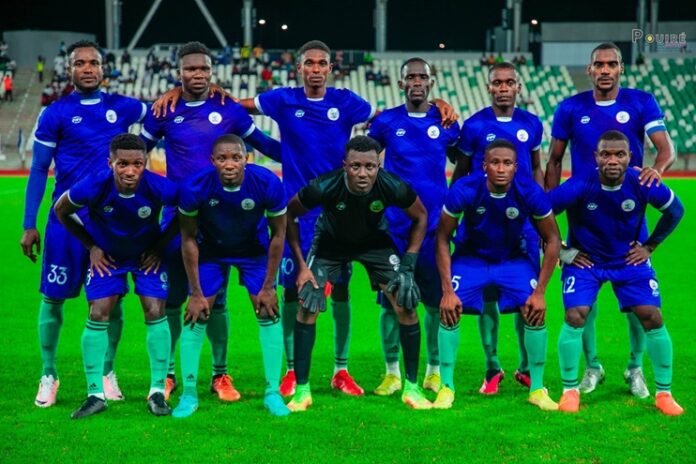
February 16, (THEWILL) — The final whistle echoed across the pitch in Berkane on a humid February evening, leaving Rivers United’s players motionless under the floodlights, their 3-0 defeat to RS Berkane confirming what had become painfully clear over six gruelling matches: Nigerian football’s continental decline has reached a new nadir. The Port Harcourt club finished bottom of Group A with a solitary point from six matches, five defeats, and the unwanted distinction of becoming the first Nigerian side to complete a CAF Champions League group stage campaign without a single victory.
The statistics tell a stark story. Rivers United scored twice whilst conceding 13 goals, managing just one draw against Power Dynamos of Zambia before succumbing to five consecutive defeats. The weight of this failure extends beyond one disappointing campaign. Since Enyimba’s continental triumphs in 2003 and 2004, Nigerian clubs have reached the group stage 12 times, advancing on seven occasions. No team had previously endured such futility at this level, a record matched in CAF history only by Senegal’s Diambars in 2017 and Libya’s Al Nasr in 2019.
This collapse carries particular significance given Rivers United’s domestic credentials and resources. State government backing provided funding far exceeding most Nigerian sides, estimated at N1 billion for the continental campaign. The team entered the competition after breaking Nigeria’s six-year absence from this stage, overcoming Mozambique’s Black Bulls 3-2 on aggregate. Under Finidi George, a former international with European playing experience, they sat near the top of the Nigerian Professional Football League table and boasted one of the division’s strongest defensive records.

Yet the gap between domestic competence and continental success proved unbridgeable. The group draw placed Rivers United against Pyramids FC of Egypt, the defending champions, RS Berkane of Morocco, who had reached previous finals, and Power Dynamos. From the opening 3-0 defeat to Pyramids in Cairo, where Rivers managed just three shots on target, the pattern became depressingly familiar. At home in Uyo, where qualification had been secured, they lost all three group matches, including a 4-1 capitulation to Pyramids after leading at half-time.
The tactical problems were evident throughout. George favoured a 4-3-3 formation emphasising wide play and quick transitions, an approach that yielded moments of promise but exposed chronic vulnerabilities in midfield. Opponents repeatedly bypassed the centre with long balls, exploiting poor pressing intensity. Match data revealed Rivers United committed fewer than 10 tackles per game on average, compared with Pyramids’ 18. George later acknowledged his side controlled first halves but faltered after the break, citing poor decision-making and an inability to adjust to the faster pace.
These problems reflect broader structural weaknesses in Nigerian football. The Nigeria Football Federation allocates limited funds for continental travel, estimated at under $2 million annually for clubs like Rivers United, against 10 million for Pyramids. Long-haul flights to Morocco and Egypt drained energy, with jet lag cited in post-match briefings. Perhaps most damagingly, the Nigerian Professional Football League often starts late due to administrative delays, meaning clubs enter continental matches without adequate competitive fitness whilst North African opponents arrive 10 to 15 games into their seasons, match-sharp and tactically refined.
The infrastructure gap continues widening. Egyptian, Moroccan, Tunisian and Algerian clubs benefit from superior training facilities, youth academies producing technically skilled players, and professional administrative structures. They employ qualified coaches with continental experience and recruit strategically using data analysis. Rivers United trained on pitches shared with local sides, unlike Berkane’s dedicated academy complex. Nigerian clubs largely operate reactively, assembling squads through personal connections rather than systematic scouting.
The consequences extend beyond reputation. Nigeria’s CAF coefficient ranking depends on club performances in continental competition. Continued poor showings threaten the country’s allocation of slots in future tournaments. If Nigerian clubs keep failing to progress beyond group stages, the nation risks dropping from four allocated positions to fewer spots, reducing opportunities and prize money. Rivers United did collect $700,000 for their fourth-place finish, with total earnings reaching approximately $750,000, but this income cannot offset the reputational damage.
Looking ahead, Rivers United face a clear imperative: translate this painful lesson into meaningful reform. The club must lobby the federation for better scheduling and travel subsidies, drawing lessons from South African sides such as Mamelodi Sundowns.
At the continental level, this exit prompts urgent questions for Nigerian football. The last Nigerian quarter-finalist was Enyimba in 2019, and recent groups have yielded just four wins from 24 matches. Without systemic reforms addressing late season starts, logistical nightmares and the growing quality gap with North African football, Nigerian clubs will continue failing continentally. Nigerian football, rich in talent, depends on such steps to reclaim its place among Africa’s elite. The players who trudged off in Berkane carry that responsibility, turning lessons from loss into foundations for future contests.

Jude Obafemi is a versatile senior Correspondent at THEWILL Newspapers, excelling in sourcing, researching, and delivering sports news stories for both print and digital publications.