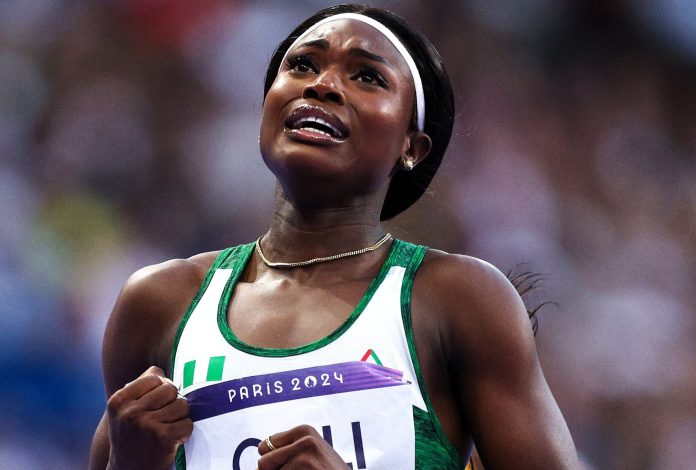
June 29, (THEWILL) — Favour Ofili, a sprinter whose career once lifted Nigerian hopes on the global track, has reportedly submitted documents to switch her allegiance to Turkey. This development, following her repeated clashes with Nigeria’s athletics administration, is coming amid growing concern over the treatment of elite national athletes.
Also, coming after key oversights from the Athletics Federation of Nigeria (AFN) and the Nigeria Olympic Committee, Ofili’s move signals deep fractures in how promising talents are managed at home and reflects wider global trends in sporting nationality.
At 22 years old, Ofili has risen quickly through the ranks. Born in Port Harcourt in December 2002, she first gained attention with strong performances at age group events. She won silver in the 400 metres at the 2019 African Games and added a bronze in the 200 metres at the World Under20 Championships in the same year . While at Louisiana State University, she set an African indoor record in the 200 metres in 2022, ran a personal best of 10.93 seconds in the 100 metres, and lowered the 200metre mark to 21.96 seconds, establishing herself as Nigeria’s fastest female sprinter over that distance . Her rise exceeded expectations when she entered the final in the women’s 200 metres at the Paris 2024 Olympic Games, finishing sixth in her debut final .

Yet, these achievements were marred by two significant administrative failures. Ofili qualified for the Tokyo 2020 Olympics but was barred from competing owing to Nigeria’s failure to complete mandatory antidoping tests. She was among 14 athletes who missed out on the Games, an outcome that left her publicly frustrated. When she qualified again for the 100metre event at Paris 2024, she was omitted from the start list. Although she competed in the 200 metres and reached the final, she expressed intense disappointment in a social media post that later drew an investigation.
These errors were neither quickly nor properly addressed. An investigative committee was set up after Paris to examine the omissions in Ofili’s Olympic entry, but its recommendations, such as financial compensation and an apology, left much to be desired. With ongoing harm resulting from that oversight, Ofili reportedly relayed her frustration to the Athletics Integrity Unit, stating that her decision to switch allegiance was not motivated by money but by frustration.
Formal requests appear to have been lodged with the Athletics Integrity Unit and World Athletics, beginning 31 May 2025. The AFN and the National Sports Commission (NSC), however, have stated that no official communication has been received. The AFN president described the matter as “sad, disheartening and painful” but noted that the federation would not stand in her way. The NSC claimed that Ofili remains a Nigerian athlete and that she continues to benefit from the Elite Athletes Programme, which provides grants of $20,000 per year.
Nigeria is not alone in losing its athletes in recent years. Several former Nigerian champions switched nationality at the peak of their careers. Gloria Alozie now runs for Spain, Francis Obikwelu represented Portugal and Femi Ogunode competed for Qatar. The trend extends beyond Nigerian borders. Turkey has sought talent globally and has reportedly offered athletes such as Jamaican discus gold medallist Roje Stona and shotput bronze medallist Rajindra Campbell initial bonuses of $500,000, plus monthly support. Ofili is likely to benefit from a similar arrangement. One report suggests that athletes who switch to Turkey could receive up to $500,000 as signing bonus, monthly stipends and kit provision.

Under World Athletics rules, athletes moving from one eligible country to another must wait for three years before representing the new nation. In exceptional situations, however, this waiting period can be waived, if the former federation is found to have failed its duties or if the athlete has suffered as a result. Ofili’s case may qualify, given the documented administrative failures. There is, however, no guarantee of a waiver. Until a decision is made, she may be barred from major international events until 2027 or 2028.
Authority voices in Nigerian sport have warned that Ofili’s move reflects much larger governance problems. Chioma Ajunwa, the nation’s first individual Olympic gold medallist, has described the mass departure of talented athletes as a sign of leadership failure within sports administration. Experts suggest that the AFN and NSC must be held accountable when they fail to support athletes consistently and transparently.
There are also implications at the global level. Nations like Turkey, Qatar and Bahrain have actively recruited athletes, offering financial guarantees, modern training systems and international exposure. While acquiring ready talents can improve medal chances, critics argue that such practices may disrupt the essence of national representation and turn sport into transactional exchange.
For Nigeria, Ofili’s potential departure comes at a crucial moment. She remains one of the few women globally capable of consistently running under 11 seconds for 100 metres and under 22 seconds for 200 metres. Her presence at the next World Championships in Tokyo in September 2025 and the Paris 2028 Olympics would likely have been a focal point for national athletics. With her switch, those hopes could shift to Turkey.
Rethinking how athletes are supported has therefore become even more urgent. Administrators must treat athletes with professionalism, ensure prompt and errorfree entry into competitions, and remove barriers to participation. Without this, more talents like Ofili may look elsewhere for respect and opportunity.
Favour Ofili’s talent was nurtured in Nigeria. While she will forever carry that legacy, her decision highlights a failure worth national reckoning. If she succeeds under a different name and flag, it will reflect less on her ability and more on the broken systems she had to outrun.

Jude Obafemi is a versatile senior Correspondent at THEWILL Newspapers, excelling in sourcing, researching, and delivering sports news stories for both print and digital publications.