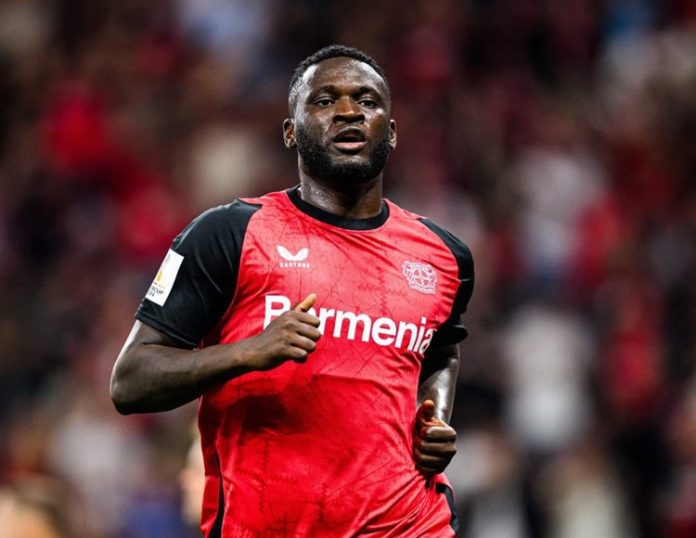
November 03, (THEWILL) — When Victor Boniface entered the pitch at the Weserstadion on Saturday evening, replacing teammate Keke Topp in the 64th minute of Werder Bremen’s match against Mainz, few could have imagined this was the same striker who, barely 18 months earlier, had been instrumental in Bayer Leverkusen’s historic unbeaten domestic double. The game finished 1-1, and Boniface managed no shots on target during his half-hour cameo. Afterwards, Werder manager Horst Steffen offered a blunt assessment of the forward criticising his performance.
Such public criticism marks a sharp departure from the acclaim that once surrounded the 25-year-old Nigerian international. What has emerged is a cautionary tale about the fragility of momentum in professional football, where a confluence of injuries, personal affairs and disrupted rhythm can derail even the most promising trajectory within the space of a single year.
Boniface’s journey to this moment began in Nigeria with Enyimba before he moved to Belgian side Union Saint-Gilloise in 2021. There, standing at 1.92 metres with evident strength in aerial duels and an ability to link play effectively, he caught the attention of scouts across Europe. During the 2022/2023 Belgian Pro League season, he registered 15 goals and seven assists in 36 appearances, prompting Bayer Leverkusen to secure his signature in June 2023 for a reported fee of around €20 million.

The timing proved fortuitous. Leverkusen, under Xabi Alonso, were building a side capable of challenging for silverware, and Boniface slotted seamlessly into an attacking unit that included Florian Wirtz and Jeremie Frimpong. What followed was a campaign that exceeded all expectations. Leverkusen went unbeaten across all domestic and European competitions, claiming the Bundesliga title and DFB-Pokal. Boniface contributed 14 goals and nine assists in 23 league matches, exceeding his expected goals figure by more than three. His aerial duel success rate stood at 55 per cent, whilst he averaged 1.2 key passes per game, demonstrating his value not merely as a finisher but as a creative force from advanced positions.
Such numbers inevitably drew comparisons with Victor Osimhen, then at Napoli, and Nigerian supporters began viewing Boniface as the natural partner to a striker who had led the Super Eagles to the 2021 Africa Cup of Nations final. Both shared similar profiles: powerful centre-forwards from Nigeria’s youth system who thrived on physicality and intelligent movement in the penalty area. By mid-2024, Boniface’s market value had climbed to €40 million, reflecting widespread interest from clubs across the continent.
Yet the seeds of decline had already been sown. A thigh muscle injury sustained during a Super Eagles match against Rwanda in November 2024 sidelined him for two months, causing him to miss nine Leverkusen fixtures. Although he returned in January 2025, the remainder of the season remained fragmented. Records show 19 appearances across all competitions, yielding eight goals and one assist. His Bundesliga minutes totalled around 1,390, a marked decrease from the previous campaign, whilst his goals per 90 minutes fell below 0.5 for the first time since arriving in Germany.
The interruptions extended beyond the purely physical. Boniface lost his mother in early 2024, an event he later described as profoundly devastating. He also suffered a road accident later that year, which further delayed his recovery and added to the mounting pressures. In public statements, he admitted that the accumulated setbacks had tested his resolve in ways he had not previously experienced, revealing that at one point he had contemplated retirement altogether.
Against this backdrop, transfer speculation intensified during the summer window of 2025. After an initially protracted transfer to the Saudi Pro League bottomed out, AC Milan pursued him aggressively, agreeing a fee with Leverkusen and conducting medical examinations in late August. However, reports emerged of abnormalities in his right knee, linked to previous injuries including two anterior cruciate ligament problems that had necessitated surgery in February 2025. The Milan medical staff raised concerns about his long-term durability, ultimately withdrawing from the deal. Boniface addressed the collapse directly on social media, explaining that the knee issues stemmed from his individualised training regime and past traumas, urging critics to reach his level before passing judgement.
With the Milan move collapsed, Boniface turned to a season-long loan at Werder Bremen on transfer deadline day, September 1st. The arrangement included partial salary coverage from Leverkusen but no option to buy, suggesting a pragmatic attempt by all parties to restore form through regular minutes rather than an unequivocal commitment to his future. Bremen, sitting mid-table, viewed him as a potential boost to their attacking options, and he passed the medical without issue despite the recent Milan concerns.
Initial signs offered cause for optimism. Boniface provided an assist on his debut in a 2-1 victory over Heidenheim, prompting predictions of a swift adaptation given his prior Bundesliga experience. Yet the goals have not materialised. By early November, he had accumulated around 191 minutes across seven league matches, mostly as a substitute, without finding the net. His sole contribution remains that opening-day assist, and the drought now stretches to 13 games across all competitions, dating back to his time at Leverkusen.
Steffen’s evolving commentary reflects growing concern. In September, the manager praised a brief cameo against Wolfsburg, expressing optimism about the player’s potential impact from the bench. By October, following a 3-1 defeat to Freiburg, his tone had shifted noticeably, criticising Boniface for lacking positional discipline and appearing scattered. Sporting director Michael Fritz attributed the struggles to physical conditioning, stating that staff had identified issues and were providing support. Reports from mid-October highlighted weight gain as a contributing factor, with Boniface needing to shed extra kilos to regain sharpness. His market value subsequently halved, representing the largest single-month drop among Bundesliga players.
The contrast with Osimhen has become increasingly stark. The 27-year-old spent the 2024/2025 season on loan at Galatasaray following contract disputes at Napoli, scoring 26 goals across all competitions with a goals per 90 rate above 0.75. His expected goals overperformance reached 4.1, and he maintained a 60 per cent success rate in aerial duels. Whilst Boniface’s creativity once set him apart, with 12 key passes in 2023/2024 compared with Osimhen’s eight, injuries have significantly muted that advantage. While Osimhen’s physical resilience and work rate has allowed him to surge back from setbacks effectively, the same has not been the case for his younger compatriot.
What remains unclear is whether Boniface’s current struggles represent a temporary phase or the beginning of a more prolonged decline. Bremen’s mid-table position offers opportunities to rebuild confidence through consistent minutes, something that eluded him at Leverkusen. The club has demonstrated faith by starting him twice early in the loan spell and planning additional minutes ahead of the winter break. Should his form improve markedly, a recall to Leverkusen in January 2026 remains theoretically possible, though Leverkusen has already moved forward with alternative striking options under new manager Kasper Hjulmand.
For the Super Eagles, Boniface risks missing the build-up to the next Africa Cup of Nations due to club fitness considerations. Nigeria manager Eric Chelle has weighed his potential against Osimhen’s established reliability and gone with the latter. It is unlikely that Boniface will feature in the World Cup playoffs even if he is able to string together a sustained run of matches, as national team managers prioritise current form and the quality of minutes players enjoy at club level rather than past achievements or future promise.
The coming months will prove decisive. Regular starts and steady minutes at Werder represent the immediate objective, with gradual improvement in shots per game and touches inside the penalty area serving as measurable indicators of recovery. Success will not be defined by overnight transformation or by overtaking peers, but rather by becoming a dependable attacking option who adds clear value to team play whilst maintaining the fitness to meet the full demands of league football.
Beyond the statistics and tactical considerations lies a human dimension often overlooked in public discourse. Young players struggle to manage the pressure accompanying high transfer fees, constant media scrutiny and relentless comparisons to established stars. A stabilising environment, a manager who demonstrates trust and a medical team aligned on rehabilitation protocols provide practical supports that reduce external stress. If expectations can be recalibrated and focus maintained on incremental, measurable progress, the loan arrangement could offer Boniface the quieter environment necessary for genuine recovery.
At 25, time remains on his side, yet the window narrows with each missed opportunity. Boniface retains evident technical and physical attributes, but those tools prove useful only if deployed consistently. Whether his recent decline represents a temporary setback or the start of a longer pattern will become clear through simple indicators: maintaining fitness, accumulating minutes and converting chances when they arrive. These steps will not erase past headlines, but they will provide a fair assessment of where he stands and what he can still deliver for club and country.
The path from Leverkusen’s heights to Bremen’s bench traces a familiar pattern for young African strikers, where brilliance becomes interrupted by bodies that betray under accumulated load. His story serves as a reminder of football’s essential fragility, where the gap between promise and fulfilment can narrow or widen with alarming speed. The drought will end when it ends, but the work to prevent another begins in dawn training sessions and the incremental rebuilding of belief, one match at a time.
Jude Obafemi is a versatile senior Correspondent at THEWILL Newspapers, excelling in sourcing, researching, and delivering sports news stories for both print and digital publications.