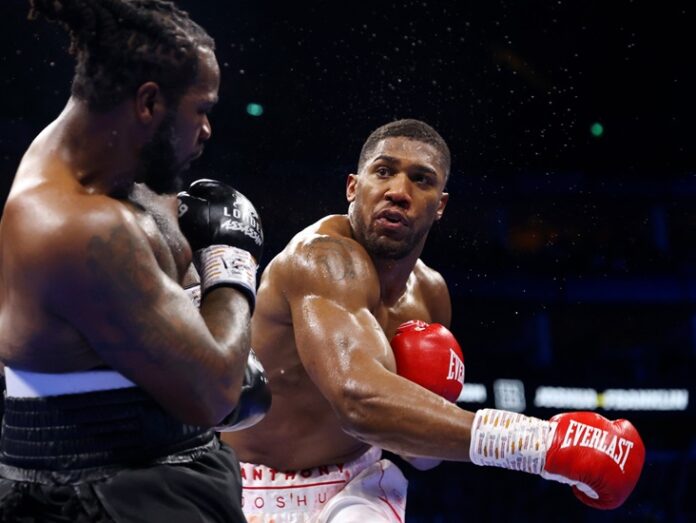
November 17, (THEWILL) — The world of combat sports finds itself at a curious crossroads, one where Olympic gold medals and YouTube stardom might soon collide inside a professional boxing ring. Anthony Joshua, the former two-time unified heavyweight champion, is in advanced negotiations to face Jake Paul, the Internet phenomenon who has spent recent years converting social media celebrity into boxing credibility. What emerges from these discussions promises to be far more than a simple bout between mismatched opponents. Instead, it represents a fundamental challenge to boxing’s traditional hierarchy, where sporting merit has historically determined who deserves the spotlight and who commands the greatest financial rewards.
The negotiations accelerated rapidly following the collapse of Paul’s planned contest with Gervonta Davis, with reports from sources close to both camps suggesting the fight is nearing completion. Yet Joshua’s promoter, Eddie Hearn, has maintained a notably cautious tone, insisting that whilst talks are progressing, no contract has been signed. This disparity in messaging captures the current atmosphere perfectly: confident anticipation from Paul’s camp contrasts sharply with careful verification from Joshua’s team, reflecting the enormity of what hangs in the balance for both fighters.
At the heart of these discussions sits an almost incomprehensible financial proposition. Sources suggest the total purse could reach approximately £140 million, to be split evenly between the two combatants. This figure would place the contest amongst the most lucrative fights in Joshua’s career, surpassing even some of his world title bouts. Hearn himself has acknowledged the attraction, admitting that an opportunity has arisen for his fighter to earn fifty times what he would have collected from the minor tune-up bout originally scheduled for this period. The business reality is stark: the potential for this extraordinary payday has superseded virtually all other sporting considerations, demonstrating just how dramatically the financial landscape of boxing has shifted.

For Joshua, however, the risks extend far beyond the physical dangers inherent in any heavyweight contest. A victory, whilst expected, would generate little credit within the boxing fraternity. A defeat, conversely, would constitute nothing short of catastrophe. Joshua is attempting to rebuild his career following a painful knockout loss to Daniel Dubois in September 2024, a setback that derailed his momentum towards another potential world title challenge. Should he suffer defeat at the hands of a man who began his career posting videos online, the damage to his legacy would be irreparable. His motivation, therefore, is to secure an immense fee whilst simultaneously silencing critics and re-establishing his elite status through decisive victory.
Paul’s motivation operates on an entirely different plane. His professional record includes victories over mixed martial arts fighters and former boxers past their prime, yet he has never faced a current, world-level heavyweight. Stepping into the ring with Joshua represents an enormous leap in competition, particularly as Paul will be moving up from the cruiserweight limit to compete in a true heavyweight contest. For the younger fighter, the pressure is minimal. A loss to a two-time champion would be expected and would change little, whereas even an improbable victory would instantly establish him as a legitimate force in combat sports. Paul himself has described this potential bout as the most dangerous challenge of his career, a viewpoint that underscores both his ambition and the severity of the undertaking.
Crucially, the contest would not proceed as an exhibition. According to reports from both camps, the match would be sanctioned as a professional heavyweight bout fought under Queensberry rules, meaning the result would officially appear on both men’s professional records. The fighters would wear standard ten-ounce gloves and compete in three-minute rounds. This distinction from Paul’s modified exhibition against Mike Tyson heightens both the danger for the younger fighter and the scrutiny for the veteran, ensuring that whatever unfolds will carry genuine sporting consequences.
From a purely technical standpoint, the physical disparity is striking. Joshua stands five inches taller than Paul and will likely weigh more than forty-five pounds heavier, maintaining the natural size of a heavyweight. Paul, who has mostly competed around the 13 to 14 stone mark, faces dimensions he has never encountered. Joshua’s path to victory demands clinical professionalism, utilising his superior height, reach and amateur pedigree to control distance with a sharp, persistent jab. The danger for Joshua lies in allowing the fight to descend into a messy brawl at close quarters, where Paul’s raw power might create opportunities. Given Joshua’s recent absence from the ring and elbow operation, a focused, disciplined performance will be essential.
Paul’s strategy, by contrast, must revolve around controlled aggression and the creation of disorder. He cannot hope to win a long, technical boxing match against a fighter of Joshua’s calibre. Instead, he must use pressure and lateral movement to bypass the long jab and force exchanges on the inside, where his hooks can be deployed effectively. His best opportunity arrives in the opening rounds, before Joshua settles into rhythm.
Beyond the ropes, the fight reflects boxing’s changing financial architecture. The decision to pursue the bout stems partly from the appetite of Netflix, which is reportedly keen to stage massive, globally watched sporting contests following the success of Paul’s previous bout with Mike Tyson. The streaming platform is understood to be developing a documentary about Joshua, and this fight aligns perfectly with its strategy to draw immense viewership. This shift demonstrates how traditional television distribution models are being challenged by platforms that prioritise mass engagement over established boxing audiences.
The broader implications are profound. When Hearn speaks of the opportunity to “extinguish” Paul from boxing, he simultaneously admits that the sport has been disrupted. The fact that a world-level heavyweight, hungry to re-enter the title picture, must take such a detour for financial gain speaks volumes about the commercial realities of modern combat sports. Public reaction remains sharply divided. Purists argue that Joshua risks compromising his standing as a serious heavyweight contender, whilst others view the bout as shrewd business with significant global reach.
Practical considerations continue to complicate negotiations. Weight arrangements, the number of rounds, commission approvals and medical requirements all remain under discussion. Both camps are working through these matters carefully, aware that any misstep could undermine the potential bout. Until a contract is signed, the narrative remains open and the outcome uncertain.
What seems certain is that if this fight proceeds, it will represent a unique crossover in professional boxing, blending mainstream heavyweight competition with the social media-driven celebrity model. The coming weeks will determine whether this collision between tradition and disruption becomes reality or remains an audacious possibility, but either way, the conversation itself has already redefined the boundaries of what constitutes a legitimate heavyweight contest in the modern era.

Jude Obafemi is a versatile senior Correspondent at THEWILL Newspapers, excelling in sourcing, researching, and delivering sports news stories for both print and digital publications.