January 19, (THEWILL) — Nigeria’s third-place finish at the Africa Cup of Nations in Morocco has crystallised a familiar paradox for African football’s most populous nation. The Super Eagles departed Casablanca with a bronze medal earned through penalties against Egypt, their ninth third-place finish in the tournament’s history, yet without the continental crown that has eluded them since 2013. It was a campaign that showed genuine progress under Eric Chelle’s stewardship whilst underlining persistent deficiencies in the moments that separate commendable performers from champions.
The statistics tell a story of considerable achievement. Nigeria scored 14 goals across seven matches, the highest tally of any side in the competition, and remarkably went unbeaten in regulation time throughout the tournament. They conceded nothing in the knockout stages during normal play, a testament to defensive organisation that had been conspicuously absent in recent campaigns. Yet these impressive numbers are shadowed by the stark reality that when Nigeria faced Morocco in the semi-final, they could not find a single goal across 120 minutes before falling 4-2 in the penalty shootout.
Chelle implemented a tactical framework that gave Nigeria a clear identity. Operating primarily with a diamond midfield formation that could shift to a front three, the system emphasised high pressing to force turnovers in dangerous areas. This approach proved devastatingly effective in the group stage, where Nigeria topped their group with maximum points, dispatching Uganda 3-1, Tanzania 2-1, and Tunisia in a more competitive 3-2 encounter. The eight goals scored in this phase represented Nigeria’s best group-stage output in the competition’s history.

The knockout rounds demonstrated the dual nature of Nigeria’s capabilities. Against Mozambique, they delivered their most clinical performance with a 4-0 victory that combined individual brilliance with collective discipline. The quarter-final against Algeria produced a 2-0 win widely regarded as a tactical masterclass, with the defensive unit led by Calvin Bassey and Semi Ajayi maintaining a compact shape that neutralised Algerian threats through organised pressing and swift transitions. Wilfred Ndidi’s midfield stability proved crucial in breaking up opposition play, whilst the attacking variety provided by Victor Osimhen, Ademola Lookman, and the emerging Akor Adams suggested Nigeria possessed the depth to trouble any opponent.
Yet, the semi-final in Rabat exposed the limitations that continue to frustrate Nigerian ambitions. Faced with a well-organised Moroccan side content to defend deep before a passionate home crowd, Nigeria’s high-pressing system found itself blunted. The attack, so prolific throughout the tournament, struggled to unlock a low defensive block and Ndidi’s absence via suspension for yellow cards did not help the situation for the Super Eagles. Alex Iwobi, instrumental in Nigeria’s creative phases, found himself crowded out in midfield, severing the supply line to the forwards. The inability to adapt when primary attacking routes were blocked and Ndidi was not available suggested that for all Chelle’s work in establishing tactical coherence, the team still lacked the flexibility required to solve different tactical puzzles as they occurred.
The penalty shootout defeat carried particular sting. Victor Osimhen’s late substitution meant he was unavailable for the spot kicks, whilst Samuel Chukwueze’s miss proved costly as Moroccan goalkeeper Yassine Bounou saved two Nigerian attempts. It was a scenario that will have revived uncomfortable memories for supporters familiar with Nigeria’s history in such decisive moments.
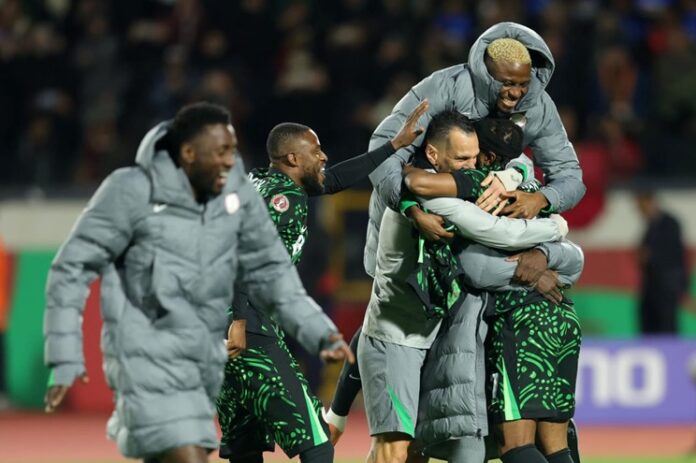
The third-place playoff against Egypt offered immediate redemption of sorts. Another goalless draw led to another penalty shootout, but this time goalkeeper Stanley Nwabali emerged as the hero. His saves from Liverpool’s Mohamed Salah and Manchester City’s Omar Marmoush secured the 4-2 shootout victory, with Lookman converting the decisive kick. Nwabali’s composure under pressure was one of the tournament’s clearest individual successes, establishing him as the undisputed first choice in goal and providing a reliability that had been absent in previous campaigns.
The broader assessment of Nigeria’s participation reveals encouraging foundations alongside persistent concerns. The defensive partnership between Bassey and Ajayi appears the most stable since the retirement of an earlier generation, whilst the emergence of younger options such as Fisayo Dele-Bashiru suggests genuine planning for squad transition. Nine different players contributed goals, reducing dependence on established stars and indicating improved team balance. The squad unity praised by Chelle throughout the campaign, maintained despite reported skirmishes between Osimhen and Lookman, protest for bonuses and other Federation difficulties, provided a platform for consistent performance.
However, the failure to convert dominance into decisive victories remains troubling. Against both Morocco and Egypt in the knockout phase, Nigeria could not find goals when it mattered most. The four goals conceded in the group stage, whilst modest, suggested vulnerability to counter-attacking strategies that better-prepared opponents might exploit. The lack of a coherent plan to bypass deep-lying defences represents a tactical deficiency that must be addressed in the post-tournament phase of the squad’s performance assessment.
The coaching situation adds uncertainty to Nigeria’s trajectory. Chelle’s impact in the time he has been in the position has been pivotal, yet reports suggest the Nigeria Football Federation will evaluate his position following the tournament. Continuity has often proved elusive for the Super Eagles, despite evidence suggesting that sustained technical leadership allows tactical ideas to embed and develop. The players have expressed support for the current direction, which argues for maintaining the progress achieved rather than resetting once again.
For Nigerian supporters, the bronze medal prompts mixed emotions. The quality of football, particularly in the knockout victories over Mozambique and Algeria, demonstrated that this squad possesses the talent to compete at the continent’s highest level and beyond. The unbeaten record in open play confirms a consistency previously lacking. Yet the wait for a fourth title continues, extending a drought now stretching beyond a decade for a nation whose footballing resources and passion demand more.
The challenge facing Nigeria is clear: translating evident quality into championship success requires mastering the decisive moments that have repeatedly proved elusive. With Osimhen and Lookman entering their prime years, the talent exists. The defensive solidity has been established. What remains is to develop the tactical flexibility and mental fortitude to prevail when the pressure intensifies and familiar patterns no longer suffice. Morocco 2025 provided the blueprint on which Nigeria can build and this will determine if bronze becomes a foundation or merely another missed opportunity.

Jude Obafemi is a versatile senior Correspondent at THEWILL Newspapers, excelling in sourcing, researching, and delivering sports news stories for both print and digital publications.