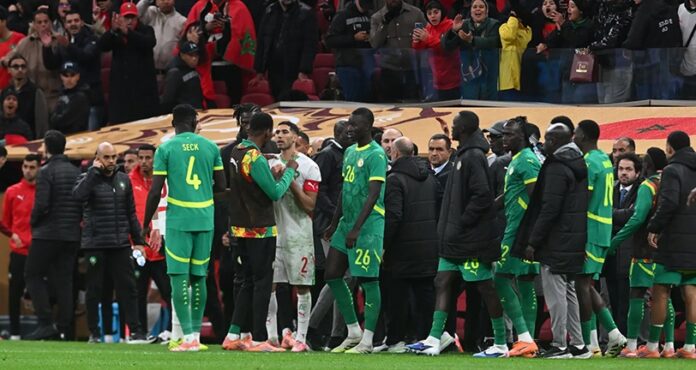
January 19, (THEWILL) — Senegal’s dramatic extra-time victory over Morocco in the 2025 Africa Cup of Nations final will be remembered not for Pape Gueye’s thunderous winner, but for the moment when an entire team walked off the pitch in protest. That extraordinary scene at Rabat’s Prince Moulay Abdellah Stadium, where Senegalese players abandoned play for more than fifteen minutes after a contested penalty decision, crystallised the tournament’s central paradox: A competition of unprecedented organisational excellence marred by persistent questions about the integrity of officiating.
The controversy reached its peak in stoppage time of a goalless final when referee Jean-Jacques Ndala Ngambo awarded Morocco a penalty following a video assistant referee review. The decision, which came moments after Senegal had a goal disallowed for an apparent foul on Achraf Hakimi, proved too much for manager Pape Thiaw, who led his players towards the dressing room. Only captain Sadio Mané remained on the pitch, eventually persuading his teammates to return. When play resumed, Brahim Díaz’s attempted Panenka penalty was saved by Edouard Mendy, and Gueye settled the match four minutes into extra time with a strike that hit the underside of the crossbar.
Morocco coach Walid Regragui later accused Thiaw of bringing shame to African football, but the Senegalese protest was merely the most visible manifestation of tensions that had simmered throughout the knockout stages. The shadow of disputed officiating had followed Morocco’s progress with troubling consistency. In the quarter-final against Cameroon, which Morocco won two goals to nil, officials overlooked what appeared to be a clear elbow by Nayef Aguerd on Christian Kofane. Cameroon officials expressed frustration over a last-minute change in referees, describing it as highly unusual. Against Tanzania in the round of sixteen, a potential penalty for a foul by Adam Masina in the dying minutes went ignored.

The semi-final against Nigeria brought similar complaints. Nigerian players and supporters questioned the performance of Ghanaian referee Daniel Laryea, particularly a yellow card to Calvin Bassey that suspended him for the next match. Some observers noted the sensitivity of appointing a Ghanaian official for a match involving Nigeria, given the rivalry between the two nations. Nigerian defenders described the officiating as terrible, claiming that small calls consistently went against them and disrupted their rhythm. One Nigerian journalist went further, suggesting that referees drawn exclusively from the continent may struggle to deliver complete fairness and calling for consideration of officials from other regions.
These concerns resonated particularly sharply in Nigeria because of a glaring absence in the tournament roster. For the second consecutive edition, not a single Nigerian referee appeared among the 73 match officials selected for the competition. This exclusion, extending a pattern that stretches back nearly two decades, proved especially difficult to accept whilst Nigerian teams competed under officiating they perceived as compromised. The Confederation of African Football’s explanation pointed to performance failures: Nigerian candidates had not passed the physical, technical and video assistant referee competency tests during pre-tournament screening. The Nigeria Referees Association president acknowledged that only one elite-rated Nigerian referee had qualified for initial consideration but failed the evaluations.
This systemic failure reflects broader problems within Nigerian domestic football. Observers linked the exclusion to inconsistent standards, compromised decisions in local leagues often attributed to unpaid salaries, and inadequate investment in modern training infrastructure. The absence of Nigerian officials has eroded international trust at precisely the moment when questions about continental officiating standards have intensified. For a nation that once produced respected officials for both African and global competitions, the current void represents not merely an administrative oversight but an indictment of development priorities.
The Confederation of African Football attempted damage control during the tournament, removing two referees after poor performances in earlier rounds and opening investigations into confrontations between players and officials. President Patrice Motsepe had emphasised before the competition that referees and video match officials had been reminded of their responsibilities to maintain strong standards and uphold integrity. Yet critics argued that actions spoke louder than words, pointing to referee changes announced less than a day before knockout matches as evidence of uncertainty and possible manipulation.
These controversies unfolded against a backdrop of near-universal praise for Morocco’s hosting capabilities. The infrastructure investment, running into hundreds of millions, delivered renovated stadiums with capacity approaching 70,000, modern transport links between host cities, and digital ticketing systems that functioned without significant delay. Pitches remained in perfect condition despite heavy rain, and security arrangements proved visible and efficient. Fans and officials from various nations described the tournament as one of the best organised in the competition’s history. The Egyptian Football Association sent a formal letter praising the infrastructure and hospitality, calling it a model for advancing African football to more professional levels.
Broadcast revenues doubled, whilst new markets in China, Japan and the United States showed increased interest. FIFA’s secretary general Mattias Grafström praised the quality and standards, linking Morocco’s performance to its upcoming role hosting the 2030 World Cup. Tunisian commentator Issam Chaouali compared the organisation to a World Cup rather than merely a continental championship, whilst British content creator Asher Glean said each match resembled a Champions League final in presentation and planning.
Yet this organisational triumph could not dispel the suspicions that Morocco’s advantages extended beyond logistics. Observers noted that tickets for knockout matches involving the hosts sold out within minutes, creating predominantly home support at crucial fixtures. The timing of ticket releases, made available before all teams had secured their places in the knockout rounds, effectively limited access for visiting supporters and generated perceptions of systematic favouritism.
The tournament’s legacy thus rests uncomfortably between two narratives. Morocco demonstrated that African nations can deliver world-class sporting events with infrastructure and planning that match the highest international standards. This represents genuine progress and offers a template for future hosts. However, the persistent questions about officiating fairness, the structural weaknesses revealed by Nigeria’s absence from the referee roster, and the unprecedented scenes of protest in the final itself expose how fragile trust in continental competition remains. High-quality stadiums and efficient transport mean little if participants and supporters believe the outcomes are influenced by factors beyond performance on the pitch. For African football to capitalise on Morocco’s organisational success, it must address the integrity questions with equal urgency. Only then will the focus shift from controversy in the press room to skill on the pitch.

Jude Obafemi is a versatile senior Correspondent at THEWILL Newspapers, excelling in sourcing, researching, and delivering sports news stories for both print and digital publications.