
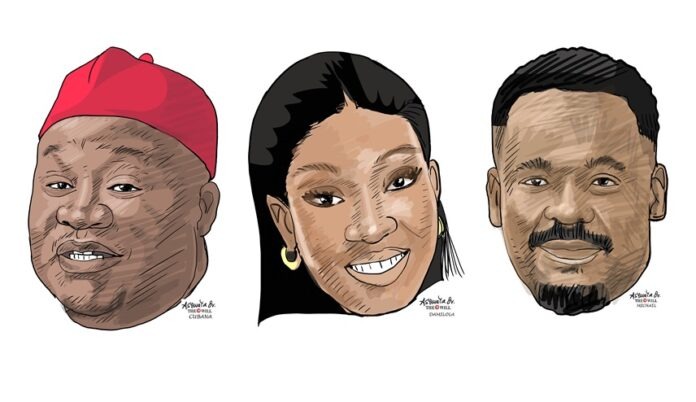
May 18, (THEWILL) — A quiet revolution is going on in Nigerian politics at the moment. Celebrity entertainers are increasingly showing interest in partisan politics. Some have openly declared political ambitions, signaling a growing intersection between celebrity influence and governance in Nigeria.
From Nollywood actors to nightlife entrepreneurs and digital personalities, many public figures are now moving beyond endorsements and campaign appearances to seek political office themselves. One of the most prominent names to recently join the political race is celebrity businessman and socialite Pascal Okechukwu, popularly known as Cubana Chief Priest.
In April 2026, Cubana Chief Priest officially declared his intention to contest for a seat in the House of Representatives on the platform of the All-Progressives Congress (APC). He is seeking to represent the Orsu/Orlu/Oru East Federal Constituency in Imo State.

The socialite announced his ambition in a video shared on Instagram after visiting the APC state secretariat in Imo State. In the video, he explained that he visited party leaders to formally inform them of his ambition and seek their support.
“I’ll be running for the office of the Federal House of Representatives. So, all I’m asking is for your blessings,” he said. Cubana Chief Priest also sought to distance himself from the typical public perception of politicians, insisting his ambition was not driven by personal gain.
“I am not coming to steal money; I want to add mine to the constituency,” he added. His political ambition did not come as a surprise to many Nigerians, considering his growing involvement in political campaigns over the last two years. The businessman currently serves as the Imo State Director of the City Boy Movement, a support group aligned with President Bola Tinubu and the Renewed Hope Agenda ahead of the 2027 elections. Cubana Chief Priest has also framed his ambition around regional interests and youth representation. He has defended his alignment with the APC, saying stronger ties with the federal government could benefit the South-East politically.
He has repeatedly argued that staying close to the center of power may help the region negotiate key issues affecting its people and strengthen its political influence. He also believes it could strengthen the South-East’s chances of producing a future Nigerian president. While supporters see him as someone with strong grassroots influence who could mobilize young voters, others argue that popularity alone should not qualify anyone for leadership. Still, his move reflects a wider trend gaining momentum across the country. He however lost to Hon. Canice Moore Omeogo by an embarrazing 4 to 2,184 votes for his opponents. He claimed that he withdrew in the race following instructions by Gov Hope Uzodinma that the position was zoned to another constituency.
Another entertainer now making the transition into politics is Nollywood actor Zubby Michael. The actor officially joined the African Democratic Congress (ADC) in April 2026 and announced plans to contest for a seat in the House of Representatives. He is eyeing the Nnewi North, Nnewi South and Ekwusigo Federal Constituency seat.
Zubby Michael picked up his ADC membership card in Ozubulu Ward 5, Ekwusigo Local Government Area of Anambra State. Unlike some celebrity aspirants who lean heavily on campaign branding, he framed his decision as a response to frustration with governance and online criticism.
“I dey my village, enough of the talking online. I don involve,” he wrote while announcing his move on social media. The statement resonated with many young Nigerians, who interpreted it as a call for action rather than online commentary.
Although this is his first attempt at elective office, Zubby Michael is not new to politics. In 2019, former Anambra State Governor Willie Obiano appointed him as Special Adviser on Media, giving him exposure to government operations. Another Nollywood figure stepping into politics is actress Foluke Daramola-Salako. In May 2026, she obtained the APC nomination and expression of interest forms to contest for the Oshodi-Isolo Federal Constituency 1 seat in Lagos State.
Foluke shared photos of herself holding the forms on social media while confirming her intention to run in the 2027 elections. Her campaign has focused on workers’ welfare, community development and public service. In one of her messages, she promised to support laws that would improve workers’ welfare if elected. Addressing constituents in another post, she described herself as a servant of the people and pledged commitment to community growth. “Together, we will build a stronger, better Oshodi,” she wrote.
She also encouraged residents to remain ambitious and focused despite economic challenges. Foluke’s political ambition adds to the growing number of female entertainers seeking political office beyond activism and advocacy.
Another notable name is Barrister Damilola Ayinde-Marshal, daughter of Fuji musician King Wasiu Ayinde Marshal, popularly known as KWAM1 or K1 De Ultimate. Damilola officially declared her intention to contest for the Lagos State House of Assembly seat representing Surulere Constituency II in March 2026 under the APC. A lawyer by profession, she currently serves as Senior Special Assistant on Tourism, Arts and Culture to Lagos State Governor Babajide Sanwo-Olu.
Her campaign focuses on youth inclusion, female representation and grassroots development. Using the slogan “Youth Lokan,” meaning “It is youth’s turn,” she has positioned herself as part of a younger generation seeking to reshape political leadership in Lagos State.
She has promised job creation, improved healthcare, better school infrastructure and women empowerment if elected. Damilola also believes young people should play a stronger role in governance rather than remain observers. Her entry into politics reflects a growing trend where children of influential entertainment figures are leveraging both political access and public recognition to enter elective politics. The increasing involvement of entertainers in politics is not entirely new in Nigeria. For decades, entertainers have played active roles in political campaigns and voter mobilization. Musicians performed at rallies, actors featured in campaign adverts, while comedians and influencers helped politicians connect with younger audiences online.
However, the situation appears different ahead of the 2027 elections. Many celebrities are no longer satisfied with supporting politicians from the sidelines. They now want to become lawmakers, decision-makers and political leaders themselves. Critics argue that popularity should not replace competence, experience or policy understanding.
Political analyst Dr. Sam Amadi says celebrity politicians often struggle with the transition from influence to governance, stressing that “visibility is not the same as capacity to govern.” Some fear celebrity politics could shift attention away from governance issues toward campaigns based more on popularity than on policy. Others believe entertainers can bring communication skills, grassroots reach and cultural influence into governance if properly prepared for leadership roles.
The trend is not limited to Nigeria. Across Africa and other parts of the world, entertainers have increasingly entered politics to build political relevance and mobilize supporters. A notable example is Ghanaian actor John Dumelo, who currently serves as Deputy Minister of Food and Agriculture in Ghana. As preparations for the 2027 elections continue, more entertainers are expected to declare political ambitions in the coming months.
Whether these celebrity candidates succeed at the polls or not, one thing is already clear: their growing presence in Nigerian politics is reshaping conversations around leadership, influence and public engagement.

Evi Ben Ezaga writes on entertainment, culture, and trending stories.
