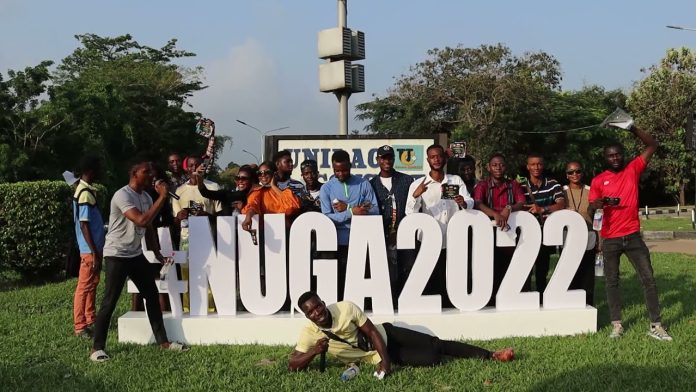
April 17, (THEWILL) – The 26th Nigeria University Games Association (NUGA) Sports competition, held at the University of Lagos, Akoka came to a successful end a few weeks ago despite an initial challenge posed by ASUU strike, Jude Obafemi writes.
In a resplendent atmosphere brimming with glitz, glamour and colour, the opening ceremony of the 26th Nigeria University Games Association (NUGA) kicked off with the symbolic lighting of the Games torch by the Speaker of Nigeria’s House of Representatives, Honourable Femi Gbajabiamila at the Sports Complex of the prestigious University of Lagos (UNILAG), which hosted the flagship inter-University competition of Nigeria. The torchlighting act signified the formal commencement of competitive events for which no fewer than 75 universities participated and for which promising athletes had devoted considerable man-hours to prepare adequately for, for anticipated glories for their tertiary institutions and possibly a shining career in sports.
At the opening ceremony, which activities continued till the late hours of Saturday, March 19, and which was graced by Nigerians from all walks of life, including dignitaries from the corporate world, Vice-Chancellors of universities and political heavyweights, there was a sense of providence.

The timing of the 26th edition coincided with an industrial action embarked upon by the Academic Staff Union of Universities, the body charged with the concerns of university academic staff, to protest the government’s failure to “satisfactorily” implement the Memorandum of Action (MoA) it signed with the Union in December 2020 on funding for revitalisation of public universities (both Federal and States), renegotiation of the 2009 FGN/ ASUU Agreement and the deployment of the University Transparency and Accountability Solution (UTAS).
The strike action, which grounded activities in all the branches of ASUU, had the potential to scuttle ongoing plans to successfully organise and host the NUGA competition and the partial or wholesome absence of many a contingent from participating institutions, but those fears were laid to rest when athletes and their handlers from universities across the country started arriving in their numbers and taking active part in the accreditation process.
The providential aspect became apparent because the downing of tools by the academic branch of the universities implied that student athletes representing their institutions were neither going to miss any lectures held in the absence during the Games, on the one hand, nor were they going to be idle as their time will be spent on events of their expertise whilst they demonstrated their skills in sporting events that could result in a career in professional sports, on the other hand.
Therefore, led by the UNILAG Vice-Chancellor, Prof Oluwatoyin Ogundipe, FAS, the hosts bid all athletes, supporting crews and guests joining the 26th NUGA Games a resounding welcome at the glamorous opening ceremony and torch lighting event. It was the fourth time, in the 56-year history of the games, that UNILAG was playing hosts. Successful hosting of the games had taken place at the institution, with their debut in 1958, followed by the 1978 and 1998 events before the current Games in 2022.
The confidence in the capacity of one of Nigeria’s most respected tertiary institutions to organise a noteworthy Games was evident in the presence of no fewer than 6,000 student athletes and officials from over 75 universities nationwide that converged in Lagos premises of the University, ready to give their best at their accredited 21 sporting events. It was a demonstration of the rationale behind the entire competition: Unity.
This rationale, which the Honourable Minister of Youth and Sports Development, Sunday Dare, noted last year, when he lit the NUGA Unity torch on Friday, November 26, 2021 to flag off preparation for the Games, was unambiguously evident in the diversity of the student athletes which cut across geopolitical zones and levels of educational strata. The mere fact that there were students athletes of representing their universities based in zones that are far removed from their places of origins against other student athletes doing the same for universities in their States of origin underpinned the unifying yet competitive spirit of the Games as intended. This underlying unifying basis of the Games continued long after the opening ceremony, as the events themselves began, both in the singles games and team sports. The athletes were of one mind, applying themselves to their sports in tough contests but embracing joyfully in victory and gracious in defeat.
The significance of the unity focus of NUGA is only matched by the other most important rationale from its inception: the grooming of future stars for the country’s sporting excellence. Honourable Dare implied this point at the opening ceremony when he definitively noted that the weeklong inter-university competition will serve as a build-up to the World University Games slated to hold later in June as well as the July Commonwealth Games. It was an unequivocal pointer to the very essence of these Games, which have consistently been a veritable springboard for budding sportsmen and women, helping them to register their potentials and be groomed for professional careers in sports. The likes of footballers Seyi Olofinjana and Vincent Enyeama started off their brilliant professional careers from the opportunity provided by the NUGA Games. In athletics, the current fortunes of Bisi Afolabi and Olusoji Fasuba, who is the reigning African record holder in the men’s 100 metres with a time of 9.85 seconds, began at NUGA. It was the same for Olumide Oyedeji in Basketball and Chika Chukwumerije in Taekwondo.
It is the chance to exhibit their sporting talents with a view to developing these potentials professionally or otherwise that student athletes from private run and government-owned tertiary institutions converged for the 26th time in UNILAG before the opening ceremony and have since then been strenuously engaged in contest after contest against counterparts from competing institutions. These institutions know that, like the names of athletes above, who began at NUGA to become household names, their institutions will always be linked to the successes that await any of their student athletes that achieves future glory as others have done at various international competitions like the Commonwealth and Olympic Games.
The institutions that made it to UNILAG 2022 include Imo State University, Owerri; Lagos State University, Ojo; Nile University, Abuja; Michael Okpara University of Agriculture, Umudike; Kogi State University, Ayangba; Nigerian Army University, Biu; University of Agriculture, Makurdi; Ebonyi State University, Abakaliki; Usmanu Danfodio University, Sokoto; University of Nigeria, Nsukki and Tai Solarin University of Education, Ijagun.
Others were Sokoto State University, Sokoto; Unversity of Calabar, Calabar; Gombe State University, Gombe; Ahmadu Bello University, Zaria; Federal University of Technology, Minna; Enugu State University of Science and Technology, Enugu; Niger Delta University, Wilberforce Island; Federal University Birnin Kebbi, Birnin Kebbi; Federal University of Petroleum, Effurun; Osun State University, Osogbo; Federal University Kashere, Kashere; Al-Hikmah University, Ilorin; Federal University of Technology, Akure; Obafemi Awolowo University, Ile-Ife; Nasarawa State University, Keffi and Modibbo Adama University, Yola. There were student athletes also representing Akwa Ibom State University, Abia State University, Uturu; Adamawa State University, Mubi; First Technical University, Ibadan; Cross River State University, Calabar; Olabisi Onabanjo University, Ago Iwoye; Benue State University, Makurdi; Abubakar Tafawa Balewa University, Bauchi; Federal University Gasua; Yobe State University, Damaturu; Umaru Musa Yar’Adua University, Katsina; Mountain Top University, Ibafo; Delta State University, Abraka; Federal University Oye Ekiti, University of Ibadan, Ibadan and University of Benin, Benin.
Institutions that were also represented at the games included Lead City University, Ibadan; Nnamdi Azikiwe University, Awka; Kaduna State University, Kaduna; Federal University, Otueke, Bayelsa; University of Ilorin, Ilorin; Ignatius Ajuru University of Education, Port Harcourt; Summit University,Offa; Yusuf Maitama Sule University, Kano; University of Uyo, Uyo; Adekunle Ajashin University, Akungba-Akoko; Ladoke Akintola University of Technology, Ogbomoso; Ibrahim Badamasi Babangida University, Lapai; Federal University, Dutse; Federal University of Agriculture, Abeokuta; Afe Babalola University, Ado-Ekiti; Taraba State University, Jaligo; University of Jos, Jos; Rivers State University of Science and Technology, Portharcourt; University of Abuja, Abuja; Bayero University kano, Kano; Federal University Lokoja, Lokoja; Borno State University, Ambrose Alli University, Ekpoma; Edo State Universiy, Iyamho; Federal University of Technology, Owerri; Federal University Lafia, Lafia; Kwara State University, Molete; Alex Ekweme Federal University, Ndufu-Alike; Ekiti State University, Ado-Ekiti; Kano State University of Science And Technology and the University of Maiduguri, Maiduguri.
As the hostilities proper began, it was not long before UNILAG demonstrated its resolve to win as hosts. Naomi Chinenye, a 200-level student of Human Kinetics and Health Education at UNILAG, scooped the first available gold medal of the Games when she finished first of 13 athletes in a time of 33:27:00 in the 5000m (5km) event. However, by Day 4, University of Port Harcourt, the defending champions, was already establishing her dominance again, taking the lead on the medals table with 29 gold, 11 silver, and 17 bronze medals for a total of 57 medals. UNILAG was in second place with 31 medals – 13 gold, 12 silver, and six bronze – while Nile University, Abuja, a surprise arrival into the top three, was in third place with six gold, six silver, and five bronze medals and 17 in all. By the end is hostilities the following day, UNIPORT had increased their haul to maintain their lead on the medals table with 60 total medals. UNILAG kept up the chase in second with 40 medals, while Nílé University remained in third place.
At the end, the shining light of the Games has not been dimmed by any means. Even in the middle of an industrial action embarked upon by ASUU, NUGA has kept its promise as a unifier and a grooming ground for the future stars of Nigerian sports.
Jude Obafemi is a versatile senior Correspondent at THEWILL Newspapers, excelling in sourcing, researching, and delivering sports news stories for both print and digital publications.