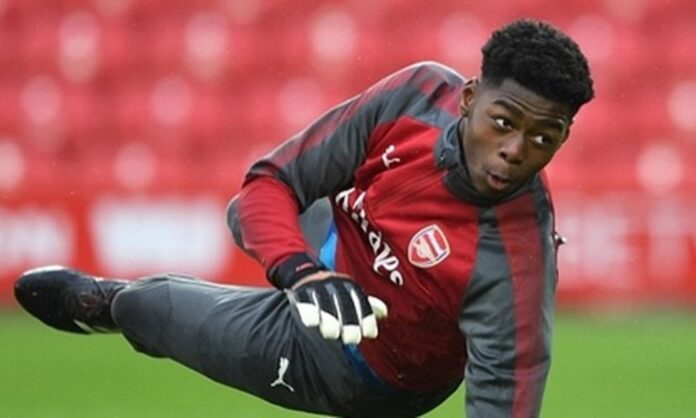
January 05, (THEWILL) — Arthur Okonkwo’s international future has been settled. The 24-year-old goalkeeper, who spent his formative years representing England at youth level, has received official clearance from FIFA to play for Nigeria, the country of his parents’ birth. The approval, confirmed in December 2025, brings immediate eligibility for the Super Eagles and marks the culmination of a process that began during conversations with head coach Eric Chelle at London’s Unity Cup tournament earlier that year.
For Nigeria, the timing could hardly be more significant. The Super Eagles are rebuilding after failing to qualify for the 2026 World Cup, a disappointment that has prompted widespread reflection within the Nigeria Football Federation about squad depth and strategic planning. Goalkeeping, in particular, has been an area of persistent debate. Whilst Stanley Nwabali has emerged as a dependable presence, the overall depth in the position has remained a concern. Okonkwo’s arrival addresses that vulnerability directly, providing competition that the Federation believes will raise standards across the board.
The London-born goalkeeper’s route to this point has been one of steady accumulation rather than rapid ascent. After progressing through Arsenal’s Hale End academy and signing his first professional contract in 2018, he found first-team opportunities at the Emirates limited. Loan spells followed: first to Sturm Graz in Austria, then to Crewe Alexandra in League One. It was his move to Wrexham in September 2023, initially on loan before becoming permanent, that proved transformative. The club’s remarkable rise through the English football pyramid has provided Okonkwo with a platform for consistent performance. He has now made 100 competitive appearances for Wrexham, playing a vital role in successive promotions that have taken the club into the Championship.

His current season statistics underline why Nigerian officials pursued him with such determination. Standing at 1.98 metres, Okonkwo has made 66 saves across 21 appearances this season, maintaining five clean sheets whilst operating in the competitive environment of England’s second tier. His physical presence allows him to dominate his penalty area during set pieces, whilst his technical education at Arsenal has equipped him with the distribution skills increasingly demanded of modern goalkeepers. These attributes, combined with a reputation for composure under pressure, suggest a player well suited to the intensity of African international football.
The mechanics of the switch were straightforward under FIFA regulations. Okonkwo represented England at under-15, under-16, under-17 and under-18 levels between 2015 and 2018, gaining valuable tournament experience but never progressing to senior level. The absence of a competitive senior appearance proved crucial: it allowed him to exercise his right to a one-time change of association, provided he could demonstrate nationality through parentage. With both conditions satisfied, the administrative process became a formality rather than an exception.
What makes this development particularly noteworthy is the context it provides about Nigeria’s broader recruitment strategy. Okonkwo joins a growing list of players raised and trained in Europe who have chosen to represent the Super Eagles, including Ademola Lookman, Alex Iwobi and Calvin Bassey. This pattern reflects both the global nature of contemporary football and Nigeria’s approach to elevated squad building. By actively engaging players of Nigerian descent who have benefited from elite European Academies, the federation compensates for domestic infrastructure limitations whilst maintaining a connection to the diaspora.
Yet, increased depth creates its own pressures. Okonkwo now enters a competitive environment that includes Nwabali at Chippa United, Francis Uzoho at Omonia Cyprus, and Amas Obasogie from the domestic league. Maduka Okoye, currently at Udinese in Serie A, recently requested to be omitted from selection due to uncertainty over his role, though the Federation has remained largely silent on his status. This constellation of options means Okonkwo faces an immediate challenge: proving he deserves selection ahead of established figures who have their own claims to the starting position.
Ademola Olajire, the Federation’s Director of Communications, has been clear that selection will be merit-based. The technical staff, he emphasised, welcomes the additional quality but will judge Okonkwo by the same standards applied to everyone else. Form, fitness and suitability for tactical requirements will determine who gets the call. This approach, whilst diplomatically phrased, acknowledges an underlying tension: how to manage expectations around a player whose profile and club environment might generate assumptions about automatic selection.
Reaction among Nigerian supporters has been enthusiastic but measured. Social media responses suggest hope that Okonkwo might address long-standing vulnerabilities, with his save statistics this season prompting speculation about whether he could immediately challenge for the starting role. Others have urged patience, recognising that adapting to international football requires time, particularly for goalkeepers who must build understanding with defenders and coaching staff in compressed training windows.
The coming months will reveal how Okonkwo fits into Chelle’s plans. Friendly matches and early qualifiers for the 2027 Africa Cup of Nations could provide opportunities for assessment. His experience in England’s professional leagues offers one perspective; the international exposure of his competitors offers another. The coaching staff must weigh these factors carefully, aware that goalkeeping errors at international level carry consequences that reverberate far beyond a single match.
Looking ahead, Okonkwo’s switch underlines a fundamental shift in how national teams construct their squads. Players with dual nationality increasingly assess their options through a lens that balances heritage, opportunity and professional advancement. For Okonkwo, representing Nigeria offers a clearer pathway to senior international football than waiting for England, where Jordan Pickford and Aaron Ramsdale occupy the senior positions. It also honours a personal connection to his parents’ homeland, giving the decision both practical and emotional weight.
Whether this move proves transformative for Nigeria’s goalkeeping fortunes or simply adds depth to an already competitive position remains to be seen. What is certain is that Okonkwo’s approval marks more than an administrative milestone. It represents Nigeria’s determination to draw from the widest possible talent pool and signals to other eligible players that the pathway remains open. For Okonkwo himself, the task ahead is clear: translate club form into international performance and justify the faith placed in him. The scrutiny will be intense, but his career trajectory suggests he possesses the temperament to meet it.

Jude Obafemi is a versatile senior Correspondent at THEWILL Newspapers, excelling in sourcing, researching, and delivering sports news stories for both print and digital publications.