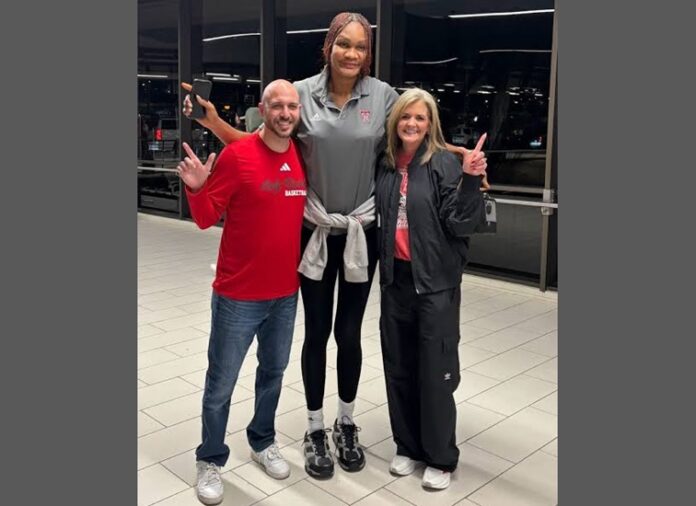
January 12, (THEWILL) — When Stephanie Okechukwu walked onto the Texas Tech campus in early January, she did so as the tallest woman ever to compete in American collegiate basketball. At seven feet one inch, with a wingspan of seven feet four inches, the Nigerian centre has already rewritten the record books before playing a single minute. Yet her story extends far beyond physical measurement, tracing a path from Umunneochi in eastern Nigeria through the disciplined basketball programmes of Kyoto, Japan, to the competitive intensity of the Big 12 Conference.
The numbers alone command attention. Previous tall players in the women’s college game, including Abbie Boutilier and Nicole Dominguez, both stood at six feet ten inches. Okechukwu surpasses them by three inches, placing her in territory previously unoccupied at this level of the sport. Only Margo Dydek, the late Polish professional who measured seven feet two inches, exceeded her height, though Dydek never played in the American collegiate system. For Texas Tech head coach Krista Gerlich, who spent more than two years recruiting Okechukwu, the physical advantages are clear. She can alter shots simply by raising her arms, secure rebounds without leaving the floor, and provide a target that opposing defences struggle to contest.
What makes Okechukwu’s arrival particularly striking is the route she took to get here. Born on February 17, 2005, though one source suggests 2002, making her age a matter of some confusion, she grew up in Abia State as one of seven children in a family where basketball was not an obvious destiny. She did not begin playing seriously until the age of 16, a late start by American standards, where elite prospects often enter structured programmes in primary school. Her development instead occurred across continents. After training in Nigeria, she played in the Philippines before moving to Fukuchiyama Seibi High School in Kyoto, where she became fluent in Japanese alongside her native Igbo and English.

That period in Japan proved formative. The culture of discipline and structure in Japanese school sport shaped her approach to training, whilst living independently at a young age prepared her for the transitions still to come. Associate coach Erik DeRoo has emphasised not just her physical gifts but her character, describing her positive attitude and genuine affection for the game. Teammates welcomed her warmly when she arrived, a moment captured on social media that showed her visibly moved by the reception. She is now the fifth international player on a roster that includes athletes from France, Spain and the Czech Republic, part of Texas Tech’s deliberate strategy to recruit globally.
The timing of her arrival carries particular weight. The Lady Raiders began the season with 16 consecutive victories, one of the best starts in the programme’s history, and entered the national rankings as genuine contenders. Yet, Okechukwu cannot immediately contribute. Like all international athletes who have competed outside the United States, she must await clearance from the National Collegiate Athletic Association, a process that involves extensive documentation and can take weeks or months. During this period, she trains with the team but watches games from the sidelines, a position that requires patience from both player and programme.
When clearance does arrive, the tactical implications will be considerable. In women’s college basketball, most centres stand between six feet three inches and six feet five inches. Okechukwu is nearly a foot taller than many opponents, creating advantages that extend beyond individual contests. Her presence forces opposing teams to reconsider offensive spacing and defensive rotations. On the defensive end, she can contest shots without excessive movement, reducing foul risk whilst maintaining rim protection. Offensively, she offers a high-percentage target in the paint, though observers note that players of extreme height often require time to adapt their movement to the pace and physicality of college competition.
The broader context matters here. Women’s basketball has seen increased investment and visibility at college level in recent years, accompanied by more sophisticated international recruiting networks. Programmes now scout talent from regions previously overlooked, supported by improved video access and youth competitions that transcend national borders. Okechukwu’s journey from Nigeria to Japan to Texas exemplifies this shift, showing how development can occur across multiple systems rather than within one established pathway.
For Nigeria, her progress carries quiet significance. Whilst football remains the dominant sport, athletes like Okechukwu increase familiarity with Nigerian talent in other disciplines. Her presence in a high-profile American programme does not constitute a national achievement in itself, yet over time such visibility influences how scouts and administrators perceive where future players might emerge. The National Sports Commission has worked to improve domestic facilities and programmes, and international success by individual athletes can support those efforts through increased attention and credibility.
At Texas Tech, Okechukwu is pursuing a business degree, balancing academic demands with athletic preparation. The university recently reported record academic performance across its athletic department, and coaches emphasise that student success matters as much as on-court contribution. Her fluency in three languages suggests intellectual capability that extends beyond sport, whilst her stated interests, reading, swimming, personal development and faith, indicate someone seeking balance amid the pressures of elite competition. She has spoken about hopes of playing professionally after college and establishing a basketball camp for young girls in her hometown, plans that position sport as part of a broader life trajectory rather than its sole focus.
The challenge now is managing expectation. Media coverage has been intense since her signing was announced, with outlets across multiple countries framing her arrival through different lenses. American sports publications focus largely on the statistical record and physical profile. Nigerian media emphasise representation and opportunity. Both perspectives carry validity, yet both risk reducing a complex individual to a single narrative. Coaching staff at Texas Tech have indicated their intention to prioritise long-term development over immediate impact, acknowledging that integration into a successful team mid-season requires careful handling.
When Okechukwu does make her debut, the moment will be noted in record books and analysed extensively. Yet what follows will matter more. Her height opens doors, but sustained contribution depends on skill development, physical conditioning and tactical understanding developed over time. The Big 12 Conference features teams that emphasise quick ball movement and spacing, demanding mobility and decision-making from all positions. Whether she can meet those demands whilst maximising her unique attributes remains to be seen.
What seems certain is that her story reflects wider shifts in how talent emerges and circulates within women’s basketball. The sport’s geography has expanded considerably, drawing players from varied backgrounds whose paths to elite competition no longer follow predictable routes. Okechukwu’s presence in Lubbock represents one outcome of that expansion, shaped by movement, education and opportunity rather than by any single system or ideology. For Texas Tech, she offers potential within an already strong programme. For observers beyond the campus, she provides a reminder that the game continues to evolve in ways that cannot always be anticipated, often quietly and over time rather than through dramatic pronouncements.

Jude Obafemi is a versatile senior Correspondent at THEWILL Newspapers, excelling in sourcing, researching, and delivering sports news stories for both print and digital publications.