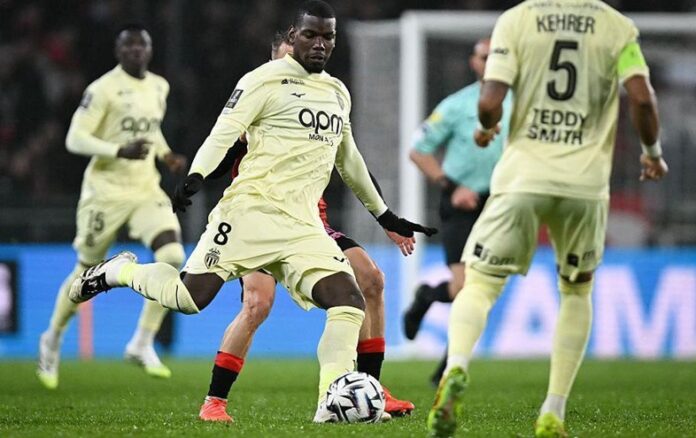
November 24, (THEWILL) — The noise inside Roazhon Park on a cold Saturday evening in late November told a story far more complex than the scoreboard suggested. AS Monaco trailed Rennes by four goals to one, yet when the substitution board went up in the 85th minute, the atmosphere shifted perceptibly. Paul Pogba, wearing the number 10 shirt, stood ready to replace Mamadou Coulibaly. What followed was not merely a routine change but the end of an exile that had lasted 811 days.
This was the closing of a chapter that nearly ended a career. The last time the French midfielder had played competitive football was on September 3, 2023, a brief substitute appearance for Juventus against Empoli. What followed that evening was a descent into professional darkness that few athletes experience, let alone recover from. Understanding the weight of those 10 minutes in Brittany requires examining the timeline of events that stripped one of football’s most recognisable figures of his livelihood and identity.
The trouble began with what should have been routine. Following Juventus’s 3-0 victory over Udinese in August 2023, Pogba underwent standard drug testing. The results were catastrophic. He tested positive for dehydroepiandrosterone, commonly known as DHEA, a substance capable of naturally boosting testosterone production. The shock was immediate, the suspension provisional. Then, in February 2024, the Italian anti-doping tribunal handed down a four-year ban. For a player turning 31, such a sentence was effectively forced retirement, a punishment that promised to erase him from the sport entirely.

During the months that followed, Pogba vanished from public view. The isolation was profound. In later interviews, he spoke candidly about the psychological toll, describing a harsh realisation regarding his social circle. When the fame and matches stopped, the phone stopped ringing. He was no longer invited to fashion weeks or high-profile events that had been staples of his life beyond the pitch. He remarked that he had to learn who Paul Pogba was when he was not a footballer, a period of forced introspection that stripped away the celebrity veneer to reveal a man fighting for his reputation.
Throughout this ordeal, he maintained his innocence with unwavering consistency. His defence rested on a single claim: the ingestion had been accidental. He had taken a nutritional supplement prescribed by a medical doctor in Florida, one that contained DHEA. Whilst the substance is not banned under United States law, it is strictly prohibited by the World Anti-Doping Agency. Pogba admitted he had failed to triple-check the packaging or consult with Juventus’s medical staff, a lapse in diligence that cost him two years of his prime. However, he insisted he was not a cheater, describing himself as a bad loser but never someone who sought unfair advantage.
The turning point arrived in October 2024. After a lengthy appeal process, the Court of Arbitration for Sport issued a ruling that vindicated his claims of unintentional consumption. The panel accepted evidence that the ingestion was not deliberate but resulted from erroneously taking a supplement prescribed by a medical professional. Consequently, they reduced his ban from four years to 18 months. The decision was a lifeline, though it came with the acknowledgement that he had failed to exercise due caution. The nightmare, as he described it, was finally over. He could return to training in January 2025 and play matches by March.
Whilst the legal victory provided a path back to football, it did not salvage his relationship with Juventus. During his suspension, the club had reduced his salary to the statutory minimum of approximately 2,000 euros per month, a stark contrast to his previous earnings. The trust and financial logic of the relationship were broken. In November 2024, shortly after the ban reduction, both parties reached a mutual agreement to terminate his contract. It was a quiet end to a second spell in Turin that had been plagued by injury and controversy, closing without farewell matches or celebration, only an announcement and the reality that a player whose value had once been immense now faced the prospect of beginning again.
Free to sign with a new club, Pogba spent the first half of 2025 training privately in Miami and Dubai, keeping his fitness levels high whilst his representatives searched for a suitable destination. Speculation linked him with teams in the United States and Saudi Arabia, yet Pogba chose to remain in Europe. He wanted to prove he could still compete at the highest level. In June 2025, AS Monaco announced his signature on a two-year contract, bringing him back to France, the country he had led to World Cup glory in 2018, but to a league where he had surprisingly little history, having left Le Havre for Manchester United as a teenager.
Monaco’s decision reflected calculated pragmatism rather than romantic rescue. Chief executive Thiago Scuro described the signing as a step to add experience to the squad. For Monaco, they acquired a midfielder whose technique, vision and passing range were once among Europe’s finest, but they also signed a player over 30 who had played very few minutes in recent seasons and carried a suspension that would always form part of discussions about him. Pogba himself expressed no expectation of immediate status, noting that his task was to earn his position through performance and daily work.
The road to his debut proved uneven even after signing. A muscle injury in October delayed his integration, followed by an ankle knock in early November. Critics questioned whether he would ever be match-fit again, and the doubts were valid. History is littered with players who returned from long suspensions only to find that the game had moved on without them. Manager Sébastien Pocognoli emphasised a gradual approach, praising Pogba’s leadership potential alongside his on-field attributes whilst carefully managing his reintegration.
When he finally stepped onto the pitch against Rennes last Saturday, the statistics of his brief cameo were modest. He completed 14 of 15 passes, won one tackle, made one interception and recovered three balls in his five minutes of play. These numbers do not set the world alight, but they represented a triumph of persistence. After the final whistle, he knelt on the grass, kissed it and closed his eyes briefly. Speaking to reporters afterwards, his relief was palpable. He admitted that the result was disappointing, his competitive edge clearly undulled, but acknowledged the emotional weight of the reception. Seeing the crowd stand and applaud touched him deeply. He confessed that he did not expect such warmth after the narrative that had surrounded him for two years.
The question now facing the footballing world is what version of Paul Pogba has returned. At 32, the explosive athleticism that defined his early years at Juventus and Manchester United has likely diminished. The game has also evolved, becoming faster and more reliant on pressing systems that require immense physical output. Pogba must reinvent himself, transitioning into a player who relies on intelligence, vision and positioning rather than raw power. His role at Monaco will likely be that of a conductor, sitting deeper in midfield and dictating tempo, using his passing range to unlock defences.
Central midfield is an unforgiving position. It requires constant movement, awareness of both sides of the field, sharp decision-making under pressure and technical execution in tight spaces. Coaches cannot carry a midfielder who offers only flashes. Pogba will need to deliver reliability, not isolated moments of quality. His earlier career featured high-profile goals, incisive passes and commanding phases of play, yet that history matters less now than his ability to produce simple, competent, repeatable contributions throughout a season.
His return also carries broader significance regarding strict liability rules in anti-doping. His case highlighted the dangers athletes face with supplements and the severe consequences of a single oversight. The reduction of his ban suggests that authorities are willing to distinguish between deliberate cheating and negligence, though the punishment for negligence remains severe. Pogba lost two years, a significant percentage of a short career, for a mistake that opened conversations about doping regulation, athlete education and how strict liability intersects with individual responsibility.
The coming months will be the true test. The few minutes against Rennes are a positive start, but playing 90 minutes week in and week out is a different challenge entirely. He has stated that his goal is to force his way back into the French national team, a lofty ambition given France’s wealth of midfield talent. Manager Didier Deschamps has left the door open, though the midfielder acknowledged that strong club form would determine any recall. Kylian Mbappé has voiced belief in his return to form, noting Pogba’s unique ability to influence matches, whilst former teammate Bruno Fernandes posted “Pogback” on social media.
For AS Monaco, the gamble is low risk but potentially high reward. If Pogba can stay fit, they have acquired a world-class talent for free. If he cannot, the contract is short enough not to be a burden. For the neutral observer, his return adds intrigue to French football. There is fascination in watching a fallen giant attempt to stand tall again, though supporters and sceptics alike will judge him on repeated actions, not moments.
The narrative of Paul Pogba has always been polarised. He has been adored for his flair and criticised for his inconsistency, celebrated as the most expensive player in the world and later reduced to a minimum-wage outcast. Now, he is simply a footballer again. The celebrity noise has quieted, leaving only the man and the ball. He said he wanted to play because it is what he loves most in the world. Watching him organise the midfield in those dying moments against Rennes, pointing, passing and moving, one could see that the love remains. He is not fighting for trophies right now but for his legacy, determined to ensure that his career is remembered for what he did on the pitch, not for the time he spent away from it. The nightmare is over, and the reality of the hard work ahead has begun.

Jude Obafemi is a versatile senior Correspondent at THEWILL Newspapers, excelling in sourcing, researching, and delivering sports news stories for both print and digital publications.