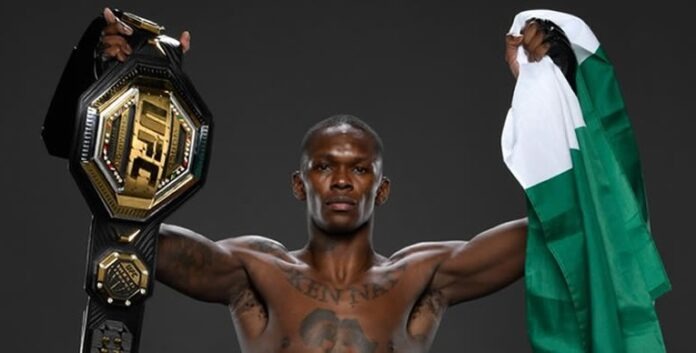
March 30, (THEWILL) — Four straight defeats. That is the measure now applied to Israel Adesanya, the man who once defined what technical striking in mixed martial arts could look like. His stoppage loss to Joe Pyfer at the Climate Pledge Arena in Seattle on March 29 confirmed what the previous three results had been suggesting: the former middleweight champion is caught in a decline that is proving difficult to separate from the ordinary passage of time, and harder still to reverse at the highest level of the sport.
The fight itself told a compressed version of the longer story. In the opening round, the 36-year-old Nigerian-born New Zealander produced the kind of controlled performance that once made him nearly untouchable. He used a precise jab to manage distance, landed repeated leg kicks, and outstripped his opponent 42 significant strikes to 36 across the first five minutes. He stopped early takedown attempts and, at one point, stung Pyfer with a jumping knee that drove the American back towards the fence. For those watching, it seemed briefly possible that Adesanya might be the version of himself the crowd hoped to see.
The second round removed that hope quickly. Pyfer found his timing with a heavy left hook followed by a straight right that visibly shook his opponent. Once the 29-year-old sensed the opening, he pressed forward and secured a takedown with roughly two minutes remaining. From a dominant top position, the American applied a body triangle and delivered the strikes that brought the referee in at four minutes and 18 seconds of round two. Adesanya’s professional record now stands at 24 wins and six losses. His last victory was in April 2023.

What makes this run significant is not simply the number of defeats but the variety of methods used to achieve them. Sean Strickland disrupted Adesanya with relentless forward movement and high-volume output. Dricus du Plessis brought physical strength and a grappling threat that left no safe position. Nassourdine Imavov ended the fight with a single clean counter in February 2025. Pyfer combined direct power striking with the willingness to close space and work on the ground. Different opponents, different approaches, the same conclusion. That pattern is harder to dismiss as a sequence of unfortunate matchups. It points instead to structural vulnerability that has developed over several camps.
Adesanya’s success in the middleweight division was built on principles that demand near-perfect execution: control of range, sharp timing, and the capacity to read opponents and adjust in real time. Those qualities allowed him to dismantle Robert Whittaker twice, recover from a knockout loss and defeat Alex Pereira in a rematch in 2023, and establish himself as one of the most creative strikers the division had seen. A striking game of that kind, however, depends more on speed and precision than one built on strength or grappling. Small declines in reaction time carry disproportionate consequences. When pressure fighters reduce the available space before those reactions can fire, the margin for error disappears.
Age features prominently in many assessments of his situation, though it does not fully account for what is happening. Fighters like Adesanya in their mid-thirties remain competitive across the sport. The more precise concern is the accumulation of high-level competition across both kickboxing and mixed martial arts over more than a decade, combined with a style that has a narrower tolerance for physical wear than one rooted in strength or grappling control. His 13-month absence before the Pyfer contest added further difficulty. Ring rust at the elite level is its own challenge, and the fight suggested that the sharpness his style requires had not fully returned.
After the stoppage, Adesanya addressed the crowd and media directly. He stated that no one would stop him, that he might lose results but would remain undefeated in his own mind, and that the night in Seattle did not mark the end of his time in the octagon. That defiance has always been a feature of his public presence. It coexists, however, with an increasingly demanding competitive reality. Before the contest he had spoken of continuing until 2027 and estimated fewer than 10 fights remained. Whether his capacity to adapt can match his will to continue is the question his team must now confront with honesty.
The broader picture extends beyond one fighter’s career. On the same evening that Adesanya was stopped in Seattle, Ojo Joy was competing in Kigali at a boxing event in Rwanda. The young boxer, who turned professional in August 2024, earned a unanimous decision over Zawadi Kutaka of Tanzania across six rounds at super-featherweight, with judges scoring the contest 60-54. It was a disciplined, technically controlled performance from a fighter who carried four gold medals from her amateur career, including at the African Games, into the professional ranks. Her record now stands at six wins from six contests.
The contrast carries meaning beyond the arithmetic. Adesanya, alongside Kamaru Usman, helped make Nigerian combat sports a subject of genuine global conversation. They established both an audience and a standard against which subsequent fighters from the country are measured. Joy operates in a different discipline and at a different stage of her career, yet she already bears the same weight of national expectation that those predecessors carried. Her progress on the continental circuit and her composure under professional lights suggest that the lineage has transferred.
For Adesanya, the options ahead are uncomfortable to evaluate. A rebuild through lower-ranked opponents might restore confidence but risks extending the losing sequence if the underlying issues remain unaddressed. A deeper emphasis on clinch work and defensive grappling would target specific vulnerabilities, though implementing fundamental changes late in a career, under competitive pressure, is rarely straightforward. Stepping away while the legacy remains largely intact is the option his instincts appear to reject.
What the four-fight losing run cannot take from him is the body of work constructed before it: the title reigns, the performances that shaped how the middleweight division was understood, and the role he played in expanding the sport’s reach among Nigerian and African audiences. That record stands independently of present results. What the present results do is sharpen the question that now faces him. Whether these defeats represent a temporary difficulty or a permanent shift will not be answered by the defiant words spoken in the aftermath of a loss. The answer will come from what happens next.

Jude Obafemi is a versatile senior Correspondent at THEWILL Newspapers, excelling in sourcing, researching, and delivering sports news stories for both print and digital publications.