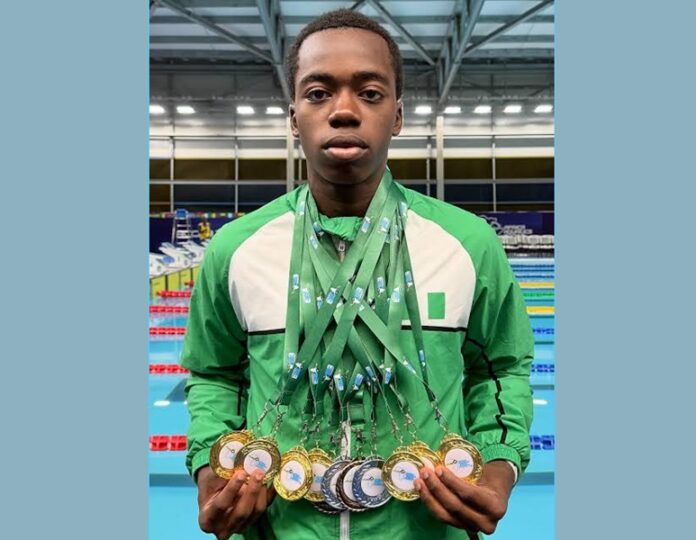
February 02, (THEWILL) — At 14, Aidan Dumuje-Abili has become the most compelling argument for Nigerian swimming’s long-overdue evolution from recreational pastime to competitive force. The Grange School student’s collection of continental medals and national records has arrived at a moment when the country’s aquatic federation is attempting to address decades of systemic neglect, making his achievements both personally remarkable and symbolically significant for a sport that has struggled to attract the investment and attention lavished on the country’s favourite sports: athletics and football.
Dumuje-Abili’s recent performance at the World School Games in Doha captured international notice. He claimed gold in the 50m freestyle and silver medals in both butterfly and relay events, competing against elite youth swimmers from across the globe. Yet these victories represent only the most visible portion of a sustained pattern of excellence that began when he was eight years old and first earned the nickname “Bullet” for his speed in the water. By 11, he had already dominated the Dolphin Swimming League with 15 gold medals in a single season, establishing himself as the fastest swimmer in his age group nationally.
The year has proved particularly fruitful. At the Africa Aquatics Zone Two Championships in Accra, he delivered what may stand as a watershed moment for Nigerian junior swimming, winning seven gold medals and one bronze across multiple disciplines. His versatility is unusual for swimmers at this stage of development, who typically specialise early. He recorded 24.73 seconds in the 50m freestyle and one minute 3.80 seconds in the 100m backstroke, times that earned high FINA points and suggested his speed could translate to senior international competition. In the 50m backstroke, his 28.42-second performance ranked as the second-fastest among all junior male competitors on the championship’s opening day.

This continental success continued at December’s Africa Youth Games in Luanda, where he won bronze medals in the 50m butterfly (25.78 seconds, a personal best) and backstroke (27.83 seconds), often competing against swimmers several years his senior. Earlier in the year, at the National Sports Festival, he took the silver medal in the men’s 100m backstroke with a time of one minute 4.15 seconds, marking his first medal at senior national level and confirming that his competitive abilities extend beyond purely junior ranks.
The progression from school leagues to international podiums reflects not just individual talent but the infrastructure that has enabled it. Grange School and the private school league system have provided the competitive environment and coaching that Nigeria’s public sporting infrastructure has largely failed to supply. What began as swimming lessons for basic water safety evolved into elite athletic pursuit through disciplined training and access to qualified instruction, a pathway that remains unavailable to the vast majority of Nigerian children.
Nigeria’s relationship with competitive swimming has been characterised by frustrated potential. The Amateur Swimming Association of Nigeria, founded in 1958 and later reorganised as the Nigeria Aquatics Federation in 2013, has overseen a sport that traces its formal competitive history to 1938 but has consistently struggled with inadequate funding, deteriorating facilities and cultural marginalisation. Football’s dominance in public consciousness and resource allocation has left swimming competing for scraps amongst other less popular sports, whilst high drowning rates have paradoxically failed to drive investment in widespread swimming education.
Recent performances suggest this may be changing. Abduljabar Adama’s silver medal in the 50m butterfly at the World Aquatics Junior Swimming Championships in 2025 marked Nigeria’s first medal at that level, achieved with a time of 23.64 seconds. Tobi Sijuade led African swimmers in the 50m freestyle at the Paris Olympics, whilst Abiola Ogunbanwo set national records at Tokyo. These achievements, alongside Dumuje-Abili’s accumulating medals, indicate that a new cohort is emerging with genuine international competitive potential.
The federation has responded with scheduled events for 2026 including the Swim to Future Championship in Abuja and preparation for the Commonwealth Games in Glasgow. World Aquatics scholarships have enabled Clinton Opute and Colins Ebingha to train in France and Hungary respectively until 2028, covering costs and competition entries that would otherwise remain prohibitive. Both hold national records and represent the kind of sustained international exposure that has historically been absent from Nigerian swimming development.
Yet structural challenges persist. Many regions lack basic facilities, and those that exist often suffer from poor maintenance. The transition from junior to senior competition requires intensive training, world-class facilities and regular international participation, all of which demand resources that remain scarce. Technical officials acknowledge the importance of managing young swimmers’ workloads carefully, occasionally withdrawing athletes from events to preserve energy and prevent burnout, a luxury that speaks to both professional planning and the thin depth of Nigeria’s talent pool.
Dumuje-Abili’s mother, herself a former runner, has provided the familial understanding of elite athletic discipline that has sustained his development. His stated ambitions to compete at the Youth Olympics and the 2028 and 2032 Olympic Games are clearly articulated, suggesting a maturity that extends beyond the pool. He has already begun developing a personal merchandise brand, indicating commercial awareness unusual in someone so young.
The broader significance lies in what his success demonstrates to the next generation. Swimming has been viewed predominantly as recreation rather than viable competitive pursuit across much of West Africa. A 14-year-old Nigerian winning gold medals on continental and world school stages fundamentally alters that perception. As more schools and clubs invest in structured programmes, the depth of competitive talent should increase, reducing reliance on exceptional individuals and building the systematic approach to youth development that has proved effective in athletics.
Nigeria stands at an inflection point. The medals accumulating in Doha, Accra and Luanda matter as proof of concept. With appropriate investment in facilities, coaching education and international competition access, the country that has produced sprinting and football excellence could establish itself as a legitimate force in aquatic sports. Whether administrators and policymakers respond with the necessary resources will determine whether Dumuje-Abili’s achievements mark the beginning of sustainable growth or remain an isolated example of what might have been.

Jude Obafemi is a versatile senior Correspondent at THEWILL Newspapers, excelling in sourcing, researching, and delivering sports news stories for both print and digital publications.